Malaysia’s push to speed up AI is backed by Belanjawan MADANI 2026, which allocates RM5.9 billion for AI initiatives, including a RM2 billion sovereign AI cloud. Yet the core tension remains: only 12% of Malaysian SMEs had adopted AI “in any meaningful capacity” as of 2024 (MDEC data cited in a 2026 report). Other figures point to faster momentum at the broader business level, including an estimate that by 2025, 27% of Malaysian businesses—roughly 2.4 million entities—had adopted AI, described alongside a 35% year-on-year increase. For small firms, the issue is less about headlines and more about what can be claimed, how quickly, and whether adoption goes beyond basic experimentation into operations.
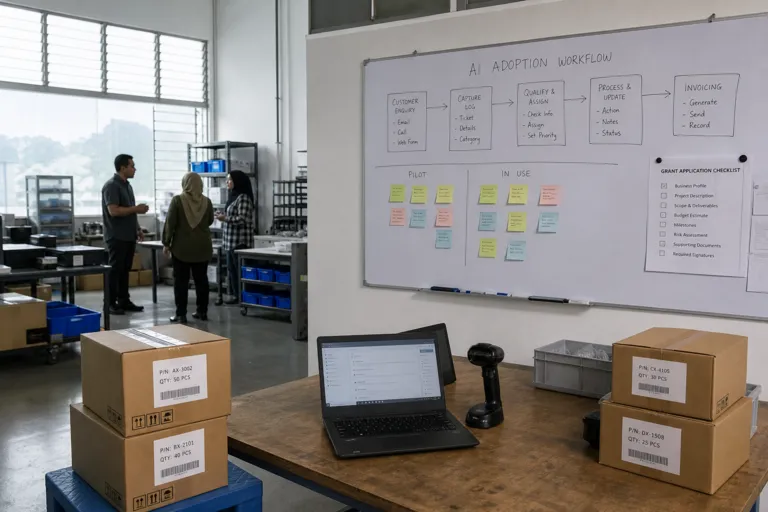
Budget mechanisms now try to lower the entry barrier for SMEs. The MSME Digital Grant MADANI offers a 50% matching grant capped at RM5,000 for approved digital tools. Examples cited include AI-enabled CRM, e-invoicing, chatbots and AI communication tools, and accounting software. One guide notes it is administered by Bank Simpanan Nasional (BSN) and is claimed via a MDEC-registered Technology Solution Provider (TSP), with approval typically taking 4–8 weeks. Eligibility requirements cited include SSM registration, at least 60% Malaysian ownership, at least six months of operating history, and SME classification under SME Corp’s definition. In parallel, Budget 2026 also set aside RM150 million for SME digitalisation grants and RM53 million for the Malaysia Digital Acceleration Grant.
From Tools to Workflows: Turning Subsidies Into Real SME Execution
The bigger gap is often skills and follow-through. One Malaysia-focused source states that 52% of Malaysian businesses identify a skills shortage as their biggest barrier to AI adoption. Budget 2026 addresses this with a specific upskilling lever: an additional 50% tax deduction for MSME spending on AI and cybersecurity training certified by MyMahir under the National AI Council for Industry (NAICI), jointly led by TalentCorp and MyDIGITAL. Separately, Malaysia’s National Training Week 2025/2026 targeted one million Malaysians across 70,000+ programmes, positioning Malaysia as strong on workforce exposure, but still challenged on converting training into operational deployment. That conversion is the “last mile” of adoption: moving from awareness to repeatable processes.
For SMEs ready to move beyond off-the-shelf subscriptions, the Malaysia Digital Acceleration Grant (RM53 million in Budget 2026) is framed as a pool for firms genuinely adopting or building with advanced technology such as AI, blockchain, IoT, and quantum. On the cost side, Budget 2026 also introduced Accelerated Capital Allowance for capital spending between 11 October 2025 and 31 December 2026, offering 20% initial and 40% annual deductions on approved plant, machinery, ICT systems, and licensed software. These instruments matter because they aim to shift SMEs from “basic tools” into organisation-wide AI workflows; one analysis argues firms that do so early can pull ahead of the 73% that are still on the basics.
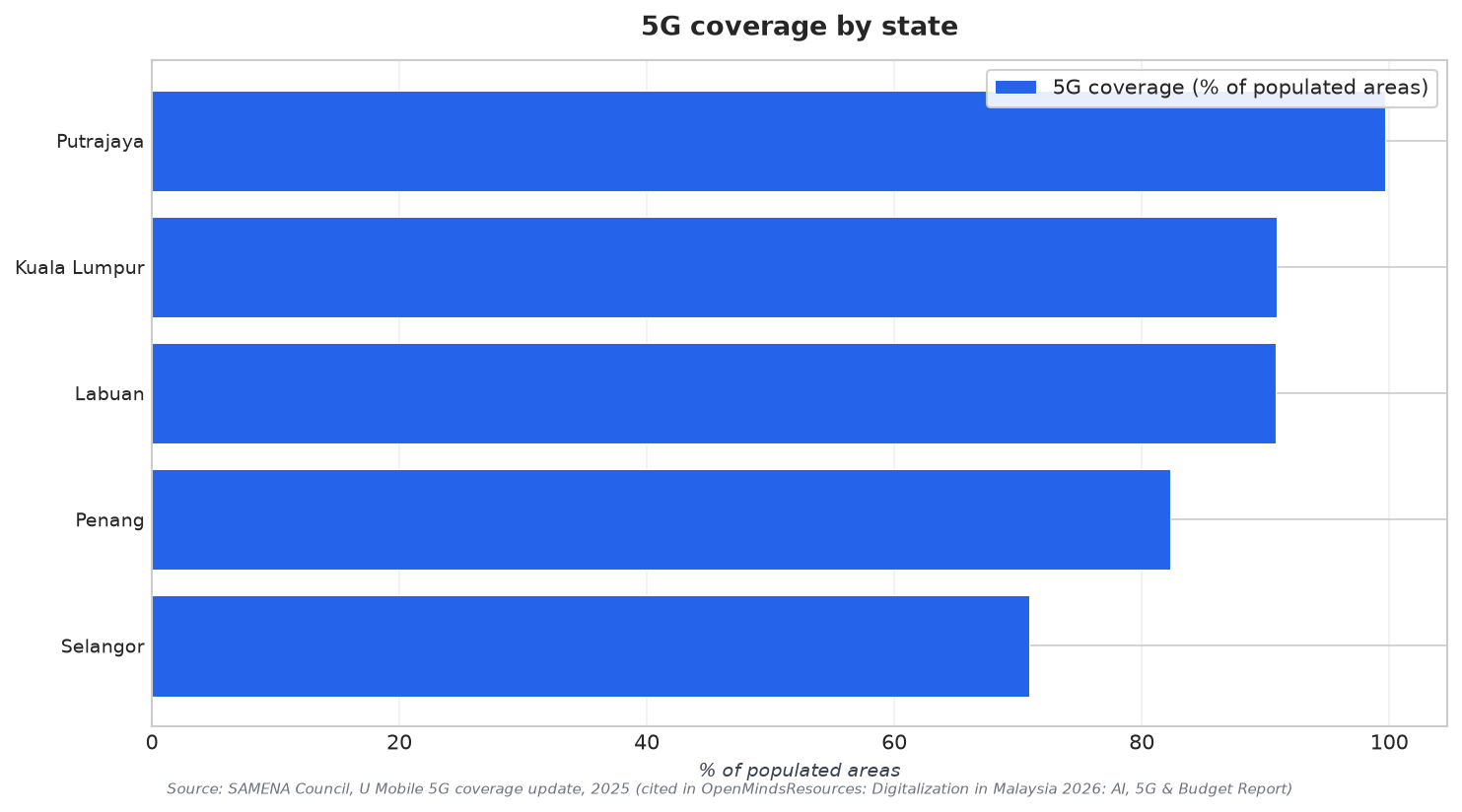
Infrastructure and market context shape how fast AI can scale in day-to-day SME operations. By end-2025, Malaysia’s 5G network reached 82.4% of populated areas, while subscriptions rose from 4.6 million (November 2023) to 28.7 million (November 2025). However, measured 5G speeds fell 46% from 2024 to 2025, highlighting the difference between coverage and capacity. At the same time, Malaysia captured 32% of Southeast Asia AI funding between mid-2024 and mid-2025, totaling USD 759 million, and four global tech giants committed over USD 15 billion to build AI and cloud infrastructure in Malaysia. In this environment, Malaysia SME AI adoption becomes a practical grant-and-skills problem: use the RM5,000 matching grant to start, pair it with training incentives, and step up to advanced grants when the business case is clear.
What is the MSME Digital Grant MADANI and how much support does it provide?
How does Budget 2026 support AI training for SME teams?
What is the latest baseline for SME AI usage in Malaysia?
What is holding back wider AI adoption among Malaysian businesses?
How are grants and incentives meant to accelerate Malaysia SME AI adoption in practice?