Malaysia’s Islamic fintech story sits inside a broader ecosystem where Shariah-compliant investing already has scale and long institutional history. One local guide describes Malaysia as a “global epicenter of Islamic finance,” and attributes more than 27% of worldwide Shariah-compliant assets to Malaysia, citing Bank Negara Malaysia. The same source states total capitalization exceeded USD 685 billion in 2024 and reports average annual growth of 8.3% over the past five years. That depth matters for fintech because digital products still rely on credible certification, supervision, and market infrastructure to earn trust, especially when new delivery models compress timelines from onboarding to investing.
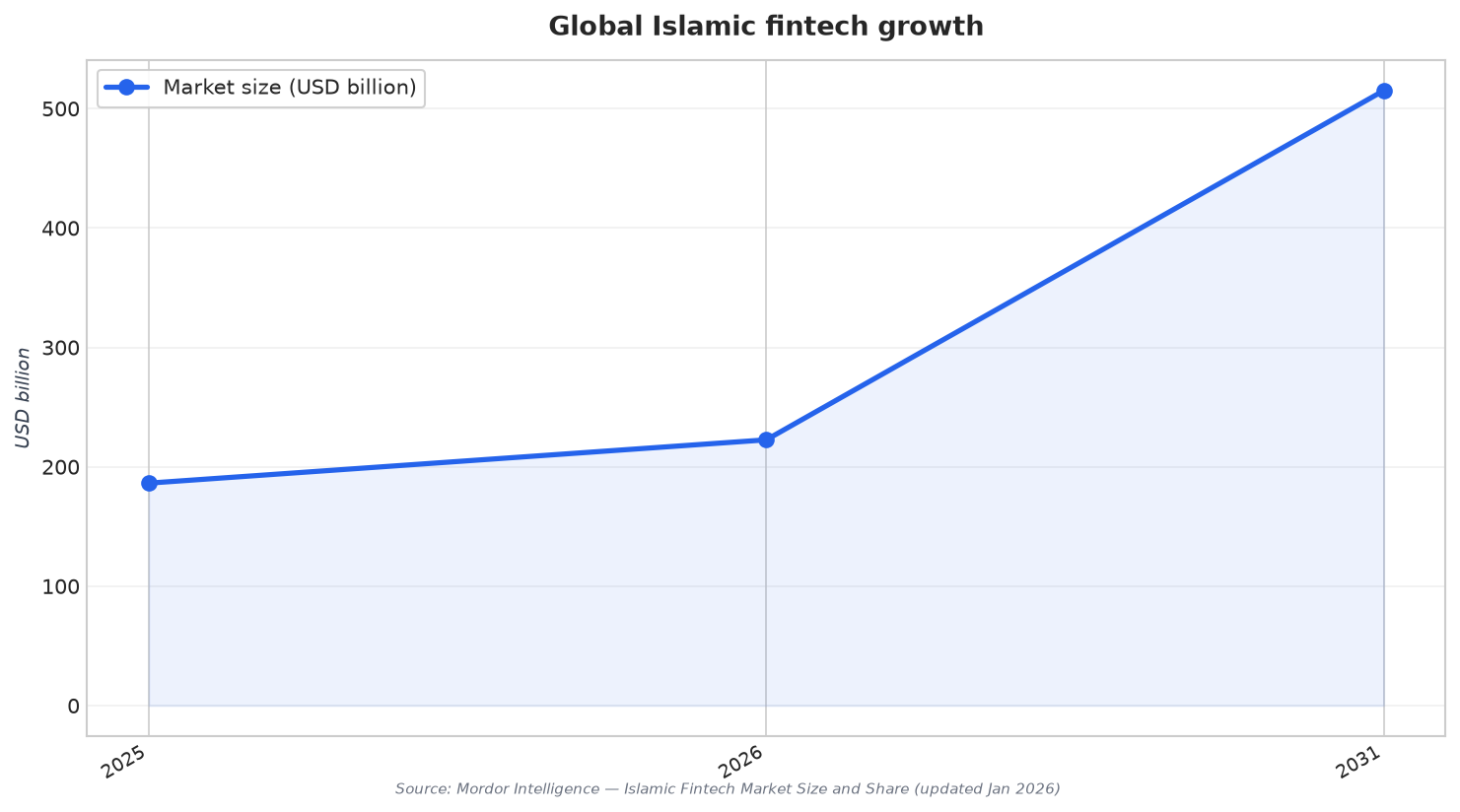
Global benchmarks help frame what investors and founders are building toward, but they should not be confused with Malaysia-only figures. Mordor Intelligence projects the global Islamic fintech market at USD 186.32 billion in 2025 and USD 222.58 billion in 2026, reaching USD 515.06 billion by 2031, with a 18.27% CAGR from 2026 to 2031. It also reports that digital payments, wallets, and remittances held 54.8% share in 2025, and cloud deployment accounted for 76.4% of the market that year. These numbers point to where product demand concentrates, and why Shariah governance tooling is increasingly viewed as an enabler rather than a back-office cost.
Shariah-Compliant P2P, Sukuk, and Halal Investing: What’s Changing
In Malaysia, Shariah-compliant peer-to-peer financing is often discussed as part of a wider push to improve access and inclusion. A Malaysia-focused study on Islamic fintech and digital banking highlights key trends such as Shariah-compliant P2P financing, robo-advisors, and blockchain-based halal investment offerings, and links these models to financial inclusion by expanding access to finance and insurance coverage. Another Malaysia paper argues that regulatory approval alone is not sufficient to ensure Shariah compliance “in substance,” and proposes a contract-centric, lifecycle-based Shariah governance framework for Islamic digital platforms. Together, these views place product design and ongoing governance at the center of sustainable P2P growth.
Sukuk remains a core bridge between capital markets and fintech distribution, especially when platforms aim to widen investor participation. Mordor Intelligence reports that outstanding sukuk crossed USD 1 trillion in Q3 2025, a global milestone that signals sustained investor attention for Shariah-compliant instruments. In the broader global Islamic finance market, Mordor Intelligence projects USD 4.53 trillion in 2025 and USD 5.10 trillion in 2026, reaching USD 8.46 trillion by 2031, growing at a 10.70% CAGR from 2026 to 2031. Its report also notes a shift in issuance patterns, including ESG-linked sukuk gaining institutional traction, and mentions tokenization pilots and lower investment thresholds as access levers.
Halal investing, in practice, is shaped by foundational prohibitions and the way Malaysia operationalizes them through product structuring and disclosure. A Malaysian Shariah-compliant investment guide explains that Islamic finance prohibits Riba, Gharar, and Maysir, which changes instrument architecture: bonds become sukuk backed by tangible assets and returns are structured around profit-and-loss dynamics rather than fixed interest. The same guide links Gharar avoidance to detailed prospectuses and enhanced disclosure in Malaysia. For Malaysia Islamic fintech builders, this translates into a clear product imperative: digital convenience must be matched with transparent documentation and governance, so that “compliance” remains a lifecycle process rather than a one-time label.
How does Islamic fintech in Malaysia connect to Shariah-compliant investing at scale?
Why is Shariah governance a major issue for Shariah-compliant P2P platforms?
What global sukuk indicator suggests rising institutional depth?
Which Islamic fintech service types dominate globally, and why does that matter for Malaysia?