Cross-border QR payments are becoming a practical layer of ASEAN’s regional integration. They build on national standards such as Malaysia’s DuitNow, Thailand’s PromptPay, Singapore’s SGQR, and Indonesia’s QRIS, with policy support and consumer demand pushing adoption. The model is simple for users and merchants. Travellers increasingly want to pay with their home e-wallets while seeing prices in local currency, and merchants receive funds in theirs, which reduces conversion complexity. For SMEs, the value is reach. QR acceptance can support tourism, cross-border shopping, and digital commerce without heavy investment in banking infrastructure.
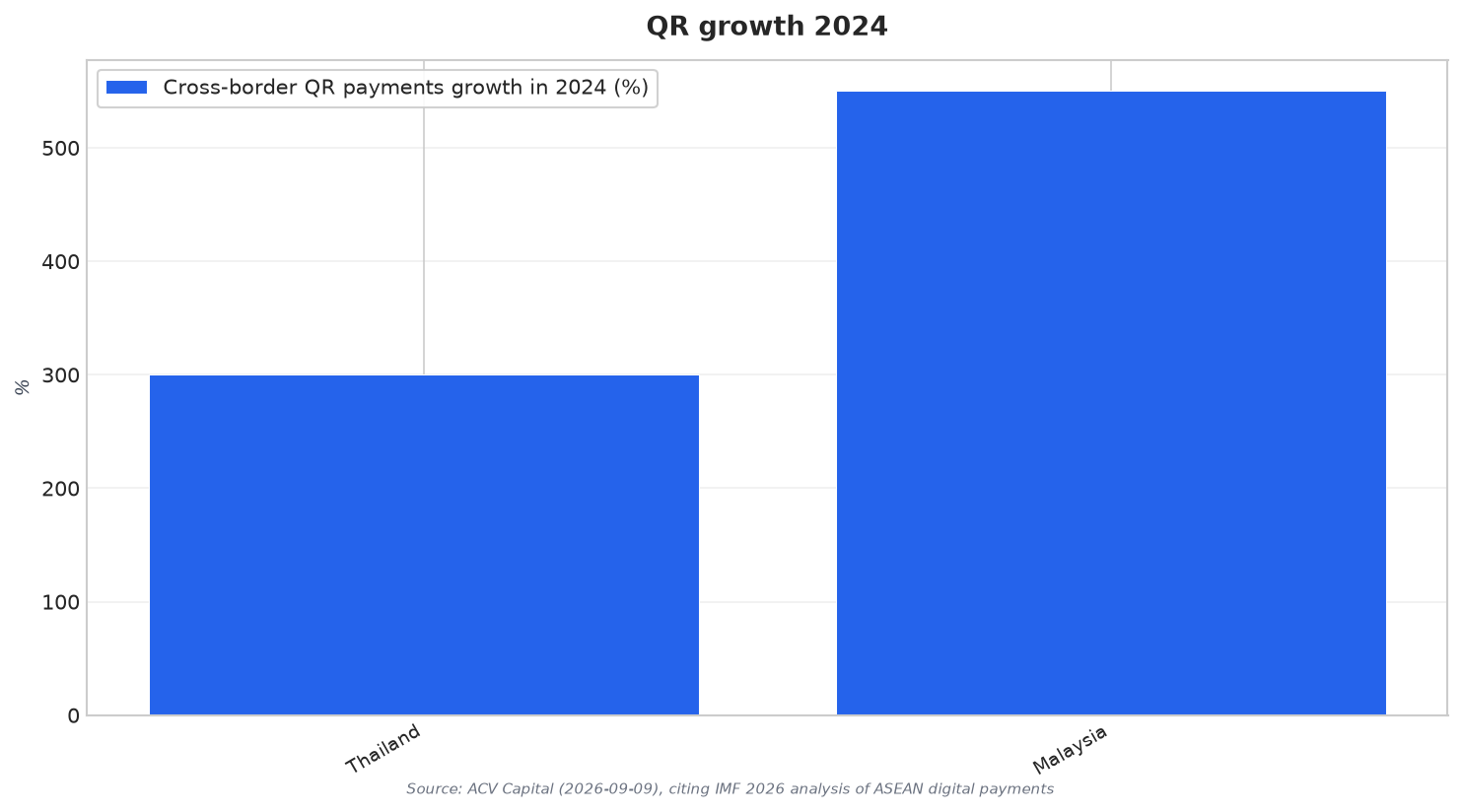
Evidence from ASEAN shows both rapid growth and clear country-specific patterns. An IMF study used a Bank of Thailand dataset covering payments from seven economies—Cambodia, Hong Kong SAR, Indonesia, Laos, Malaysia, Singapore, and Vietnam—to Thailand from 2020–2024, at a monthly aggregate level. That scope created 60 months and 420 observations, tracked by both volume and value. The same IMF analysis cited in regional reporting notes that cross-border QR payments in Thailand increased by more than 300% in 2024, while Malaysia recorded growth of 550%. Even with growth described as “still small in value and volume” in the IMF report, the direction is clear: linkages are turning QR into a cross-border tool, not only a domestic one.
From Bilateral Corridors to a Regional Payment Fabric
ASEAN’s Regional Payment Connectivity agenda frames these QR linkages as part of a broader push to lower transaction costs, promote local currency use, and support a seamless digital economy. The region’s early milestone was the PayNow–PromptPay corridor between Singapore and Thailand, described as the world’s first real-time QR linkage and a model for others. Malaysia and Thailand followed with a DuitNow–PromptPay connection, and later Singapore launched connections with Malaysia and Indonesia. Beyond ASEAN, India and Singapore created a UPI–PayNow link for low-cost diaspora remittances. AMRO also notes that similar connections link Cambodia, Indonesia, Lao PDR, Malaysia, and Vietnam, covering most of the region’s cross-border flows.
Tourism demand helps explain why interoperability matters now. Intra-ASEAN visitors accounted for 42% of total visitors in 2023, compared with 36% in 2019, creating more day-to-day need for payment methods that work across borders. At the same time, domestic rails remain the backbone beneath QR. Thailand’s PromptPay is reported to handle over 74 million transactions daily and to have over 90 million registrations. At the QR-network layer, Indonesia’s QRIS connects 40 million merchants to 57 million users, and recorded 2.6 billion transactions in a single quarter by early 2025. These domestic foundations help make cross-border QR payments credible at scale, because they are anchored in real-time systems designed for instant, low-cost transfers.
New projects aim to reduce the need for one-off integrations as more markets connect. Nine ASEAN central banks have joined the Regional Payment Connectivity initiative. In parallel, Project Nexus—backed by the Bank for International Settlements and including participants such as Indonesia, Malaysia, the Philippines, Singapore, and Thailand—is designed to connect domestic instant-payment systems through a standardised multilateral framework. Rather than building bespoke links between every pair of markets, participants could connect once to a common platform. The BIS says this architecture could enable cross-border payments to reach recipients within 60 seconds in most cases. For businesses building across ASEAN, this shift supports the move from stitching together payment methods to connecting the systems needed to operate in multiple markets.
How fast are Malaysia’s cross-border QR payments growing?
Which national QR standards underpin ASEAN interoperability for payments?
What corridors show how ASEAN built real-time QR linkages?
Why does tourism matter for cross-border QR payment adoption in ASEAN?
What is Project Nexus meant to change in cross-border payments?