Malaysia’s care agenda is becoming a practical economic issue, not only a social one. Employers, families, and government agencies all feel the pressure when childcare is hard to access or inconsistent in quality. In a nationally representative World Bank survey of Malaysian firms on inclusive employment practices, care responsibilities and compliance with maternity regulations were highlighted as major barriers. Around 40% of firms said additional benefits such as lactation rooms or childcare increase the cost of hiring women. In that same survey, firms also pointed to flexible work arrangements and childcare assistance as key measures to support women in balancing work and family responsibilities.
Childcare infrastructure is not only about adding more centres. It is also about building trust through consistent standards, clear licensing, and effective oversight. Research on childcare in Malaysia argues that improvements to the legal framework are necessary, including clearer regulations, streamlined registration, and strict enforcement, with the aim of creating safer centres and supporting economic growth. The same work notes that ineffective governance in registration and monitoring, enforcement weaknesses, and licensing loopholes were leading factors in the closing down of childcare centres in the Klang Valley. It also warns that weak horizontal integration between ministries and departments can create confusion and may contribute to unregistered centres operating to avoid complex dealings with government offices.
Why Coordination and Quality Controls Matter
International policy reviews reinforce the same point about coordination. The OECD Economic Surveys: Malaysia 2026 recommends reducing fragmentation of early childhood education and centralising responsibility for childcare and preschool education in one ministry, arguing this would facilitate coordination and quality improvements. That recommendation matters for families navigating different rules and expectations across agencies, and for operators trying to remain compliant while delivering reliable services. When responsibilities are split, operators can face shifting requirements and uneven monitoring. A more coordinated structure can support quality improvements that are easier to understand, implement, and enforce across the childcare ecosystem.
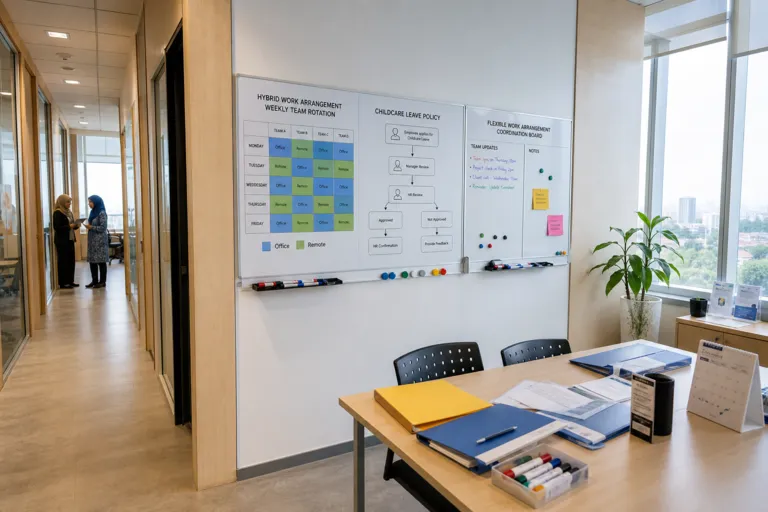
At the workplace level, flexible work is positioned as a direct lever to reduce care-related barriers. The World Bank survey suggests refining TalentCorp’s Career Comeback Program by tailoring support based on returnees’ skills and experience, while also incorporating strategies for managing productivity and efficiency into the Flexible Work Arrangement Guidelines (Aturan Kerja Fleksibel, AKF). The same set of recommendations includes broadening current tax incentives for setting up childcare centers to include alternative care arrangements. Together, these proposals reflect a practical approach: support re-entry, make flexibility easier to run operationally, and recognise that childcare support may need multiple models, not a single template.
Budget messaging also shapes how care priorities translate into action, even when line items are not spelled out in a single summary. Malaysia’s Ministry of Finance notes in its Pre-Budget Statement 2027 that Budget 2027 is the fifth MADANI Budget, guided by priorities that include raising living standards and driving governance reform. The statement also frames the need to balance protecting households from rising living costs with laying foundations for a more sophisticated economy. For the Malaysia care economy conversation, that framing matters because childcare, flexible work, and better coordination sit at the intersection of household resilience and longer-term productivity. The next step is ensuring the reforms discussed in reviews and surveys translate into clearer, easier pathways for families, firms, and childcare providers.
What do Malaysian firms say makes hiring women more costly?
What reforms are suggested to improve childcare governance in Malaysia?
What does the OECD recommend on early childhood education administration in Malaysia?
How is flexible work positioned in Malaysia’s care and employment discussions?
What is changing in the Malaysia care economy conversation right now?