Rapid delivery is becoming a defining competitive edge in Malaysia quick commerce, and the spillover effect is visible across the broader retail market. One benchmark frames the opportunity: IMARC Group values Malaysia’s retail market at USD 132.27 billion in 2025 and projects it will reach USD 186.15 billion by 2034 at a 3.79% CAGR (2026–2034). In a market where food purchases are frequent and time-sensitive, grocery-linked categories dominate. IMARC also reports food and beverages at 41.2% share in 2025, supported by expanding food delivery ecosystems and growing demand for halal-certified and health-focused products, plus modernization such as AI-based demand forecasting and automated inventory management.
At the company level, speed is pushing players to control more of the supply chain. IMARC notes that in March 2025, Grab acquired the 19-store Everrise supermarket chain to bolster its grocery retail footprint and digitize on-demand grocery delivery services across Malaysia. That kind of move matters because it links store assets, inventory, and last-mile delivery in one operating loop. It also fits the report’s view that quick growth in food delivery and quick commerce services is increasing the addressable market beyond in-store sales. The result is a faster feedback cycle between demand signals, stock positioning, and delivery promises, which can reset what shoppers expect from “normal” grocery convenience.
Grocery Delivery Speed Wars Meet Store-Scale Pressure
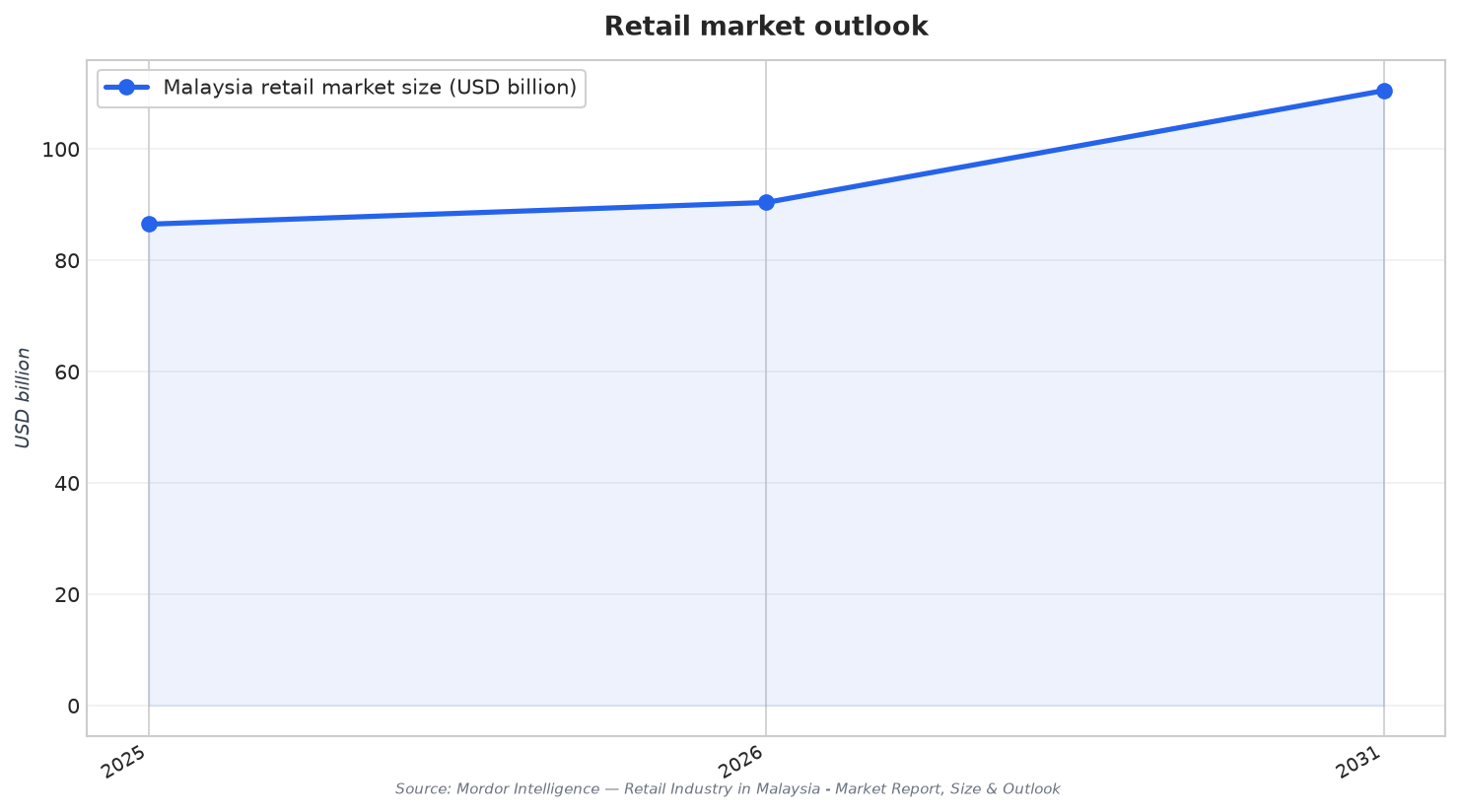
Malaysia’s speed wars are not only about delivery apps. They also collide with the scale economics of physical retail. Mordor Intelligence values the Malaysian retail market at USD 86.5 billion in 2025 and estimates growth from USD 90.4 billion in 2026 to USD 110.5 billion by 2031 at a 4.1% CAGR (2026–2031). It reports retail trade rose 6.1% in 2025 and non-specialized stores grew 7.0%, signaling continued demand for grocery, mini-market, and convenience purchases even as retailers face higher store costs. One standout example is 99 Speedmart, which reported FY2025 revenue of MYR 11.4 billion (USD 2.6 billion) after 14.5% growth, reached 3,037 outlets by December 2025, and set an annual target of 250 new stores.
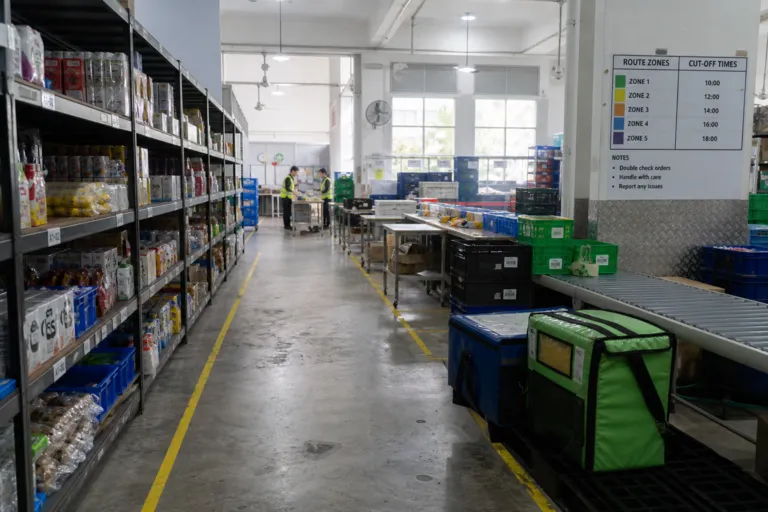
Fulfillment capability is now the constraint that decides who can credibly promise “faster.” In Malaysia’s e-commerce market, Mordor Intelligence says food and beverages are poised for the quickest 16.46% CAGR through 2031, driven by quick-commerce models that promise 30-minute delivery. But it also flags that fulfillment and delivery remain the main physical constraint, especially for East Malaysia, where high last-mile and inter-island costs raise basket prices and complicate returns. The same source points to government incentives such as the Smart Logistics Complex (SLC) program (2025–2027) to accelerate Industry 4.0 adoption in warehousing and distribution, and highlights YCH Group’s RM500 million Supply Chain City Malaysia alongside continued automation investments across warehousing.
Regional context explains why delivery-time expectations keep tightening. In the Asia-Pacific online grocery delivery market, Mordor Intelligence reports same-day and next-day services held 53.48% share in 2025, while the ≤30-minute category is forecast to post an 18.74% CAGR through 2031. It also states aggregator platforms commanded a 71.86% share in 2025. Global context shows the intensity of this shift: DemandSage reports quick commerce is growing at a CAGR of 34.3% versus e-commerce at 14.6%, and that quick commerce “guarantees” delivery in 10–30 minutes, with 70% of the global market concentrated in this ultra-fast segment. In Malaysia, the practical outcome is clearer priorities: inventory near customers, smarter warehousing, and economics that can survive the delivery clock.
What is driving the rise of fast grocery delivery in Malaysia?
How fast are quick-commerce models promising delivery in Malaysia’s e-commerce market?
What constraints could slow rapid delivery expansion, especially outside key urban areas?
How does Malaysia quick commerce fit into wider Asia-Pacific delivery trends?
Why are store networks still relevant in the rapid delivery era?