Malaysia’s healthcare system is under growing strain as demand rises faster than the supply of trained staff. Ageing is a major driver. Malaysia’s population aged 65 and above was 7.74% in 2024, up from 7.45% in 2023 and 7.19% in 2022, while the old-age dependency ratio rose to 10.98% in 2024 from 10.61% in 2023 and 10.27% in 2022. In parallel, Malaysians aged 60 and above made up 11.6% of the population in 2024, and projections indicate the country will reach 15% by 2030 and become an aged society. This context frames the Malaysia healthcare workforce shortage as a timing problem: demand is increasing now, while workforce pipelines move slowly.
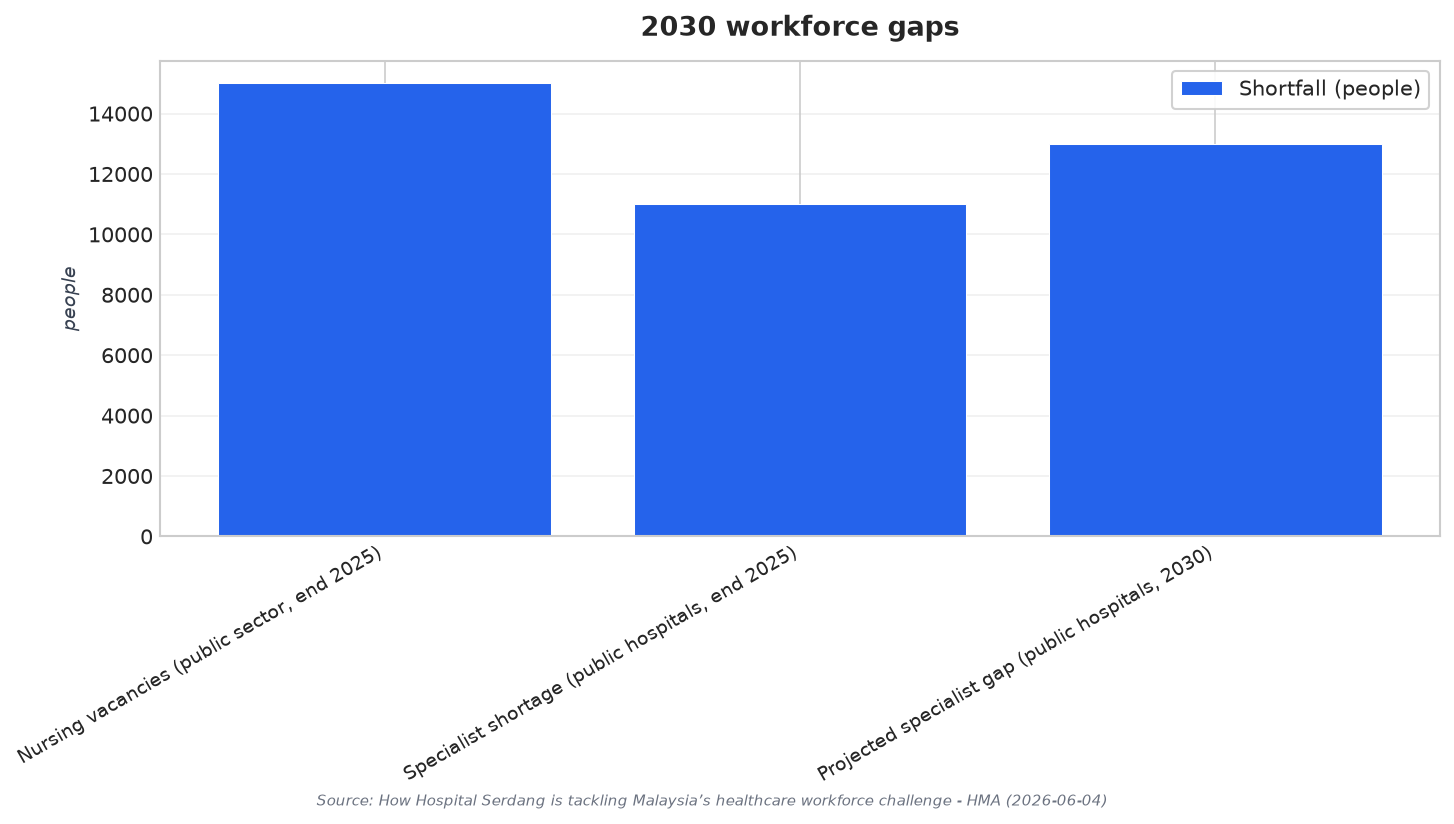
Nursing is one of the clearest pressure points in public care. As of June (as reported by CNA), Malaysia’s public healthcare sector had 14,000 nursing vacancies. Another report (HMA) said that as of end 2025, public hospitals had close to 15,000 nurse vacancies left unfilled. The Health Ministry has also warned that the shortfall in the nursing workforce could reach nearly 60% by 2030. These figures sit alongside structural issues described in public-hospital settings, where limited financial flexibility is linked to heavily subsidised outpatient consultation and specialist fees set at a token RM1 and RM5 per visit for decades, making it harder for the system to compete on salaries and perks.
Specialists and Geriatric Care: The Tightest Bottlenecks
Specialist capacity is also described as especially acute in public hospitals. HMA reported that, as of end 2025, public hospitals were short of over 11,000 specialists, and that the gap will grow to 13,000 by 2030 at the current pace of 1,000 to 1,400 new specialists annually. The same report attributes the gap to training bottlenecks, limited permanent posts, slow career progression, and migration to private or overseas hospitals. In acute hospital care specifically, Ken Research described a deficit of approximately 35,000 doctors and nurses, warning that rising demand can lead to overworked staff and potential declines in patient care quality.
Geriatric medicine illustrates how the staffing shortfall intersects with ageing. CodeBlue reported that Malaysia has roughly 60 geriatricians serving the nation, for 3.9 million elderly citizens, or about one geriatrician per 65,000 older Malaysians. This is contrasted against a Ministry of Health-cited ideal of one specialist per 10,000 people. CodeBlue also cited an estimate that Malaysia would need at least 549 geriatricians by 2030, based on SEDAR Institute’s analysis of MOH parliamentary data, but current training output is roughly eight geriatricians annually. A separate editorial on healthy ageing by 2030 similarly notes that Malaysia is still developing geriatric care infrastructure and faces a shortage of professionals trained in geriatric medicine, limiting tailored care for older adults.
Policy and operational responses are emerging, but the numbers show why momentum matters. The 13th Malaysia Plan (RMK13), as cited by CodeBlue, sets a target to grow the number of trained care workers from 43,000 to 50,000 by 2030, even as Malaysia’s elderly population is projected to exceed 3.9 million in the same period. At the facility level, Hospital Serdang has introduced contract opportunities for retired nurses and strengthened its role as a training site for nurses pursuing post-basic and specialty certifications. Yet public hospitals still face the combined reality of nurse vacancies, a rising specialist gap, and the need to build geriatric capacity fast enough to match the country’s shift toward an aged society by 2030.
What is driving Malaysia’s healthcare workforce shortage toward 2030?
How large is the nursing vacancy problem in Malaysia’s public sector?
How big is the specialist shortfall in public hospitals, and what is projected for 2030?
How many geriatricians does Malaysia have, and what is the 2030 need?