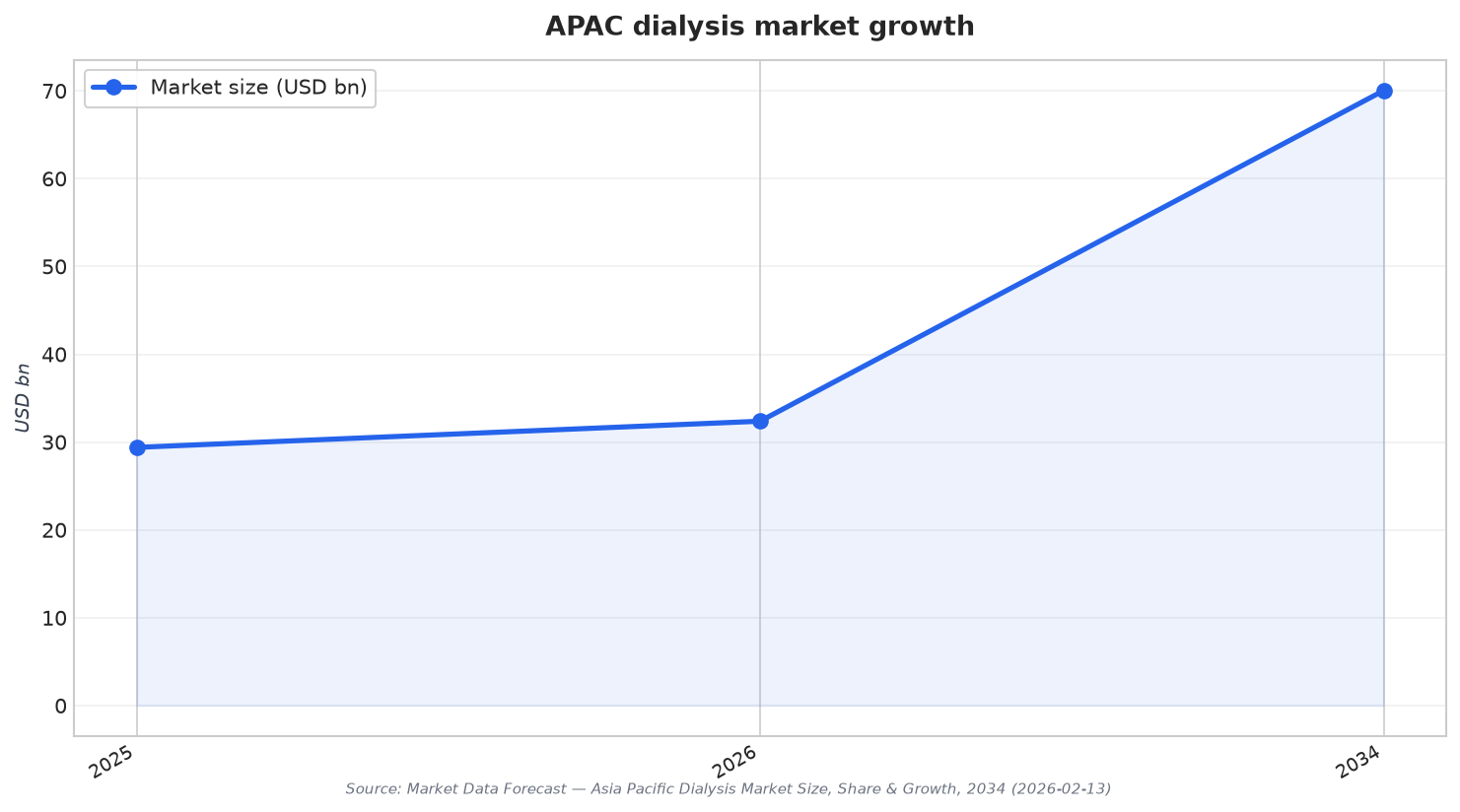
Malaysia’s dialysis market sits inside a broader Asia Pacific upswing in renal care demand. The Asia Pacific dialysis market was valued at USD 29.40 billion in 2025 and is anticipated to reach USD 32.38 billion in 2026, with a forecast of USD 70.02 billion by 2034 at a CAGR of 10.12% from 2026 to 2034. Regional reports link this momentum to chronic kidney disease (CKD) growing alongside diabetes and hypertension. The World Health Organization notes hypertension affects more than 1.1 billion people globally, and the same regional narrative highlights delayed diagnosis and fragmented primary care as drivers that push patients into advanced renal failure before treatment begins.
Within Malaysia, available equipment-side signals show where demand concentrates. In the Malaysia hemodialysis equipment market, End Stage Renal Disease (ESRD) is described as the largest segment, with revenue of USD 44.20 million in 2024. By end user, clinics and dialysis centers are the largest segment, with revenue of USD 47.11 million in 2024. Growth is not limited to machines alone. Hemodialysis consumables are cited as the fastest growing segment, with a growth rate of 6.97% for 2025–2032, while retail sales is listed as a fastest growing segment with a growth rate of 6.38% across the same forecast period. These segment splits suggest a market where recurring usage and channel expansion matter alongside capital equipment.
Insurance Coverage Gaps and Why Reimbursement Matters
Coverage design can change how quickly patients enter therapy and where they receive it. In Japan, a cited example shows how policy can strengthen access: with a universal healthcare system and a National Health Insurance (NHI) scheme, the government covers 90% of treatment cost, improving patients’ willingness to seek treatment. The same source ties demand to demographics and risk factors, noting Japan Statistics Bureau estimated 29.1% of the population was aged 65 or more in 2023, and reporting hypertension affects nearly 43% of adults based on a 2021 census survey. For Malaysia, these figures should be read as international context, but they underline a practical point: when reimbursement is strong, dialysis utilization can be supported at scale, while gaps can create barriers even when clinical need is rising.
Private provider growth is a repeated theme across comparable markets, and it connects directly to capacity build-out. In the Philippines, the dialysis centre market is valued at approximately PHP 99.5 billion, with growth drivers including increasing CKD prevalence, an aging population, and advancements in dialysis technology; the same report states independent/free-standing clinics are rapidly expanding, alongside government funding for sessions through the national insurer, PhilHealth. Malaysia’s provider mix will differ, but this regional pattern helps explain why clinics and dialysis centers show up as the largest end-user segment in Malaysia’s hemodialysis equipment market in 2024. For investors and operators watching Malaysia’s dialysis market, the signal is that center-based delivery remains commercially and clinically important while policy decisions can amplify or constrain access.
Equipment trends across Asia Pacific also point to how service models may evolve in Malaysia over time. The Asia Pacific dialysis equipment market was valued at USD 4.51 billion in 2025, is estimated to reach USD 4.96 billion in 2026, and is projected at USD 10.56 billion by 2034, growing at a CAGR of 9.9% from 2026 to 2034. The same source highlights trends including rising adoption of home-based and peritoneal dialysis solutions, and increasing integration of IoT-enabled and smart dialysis machines for remote monitoring and personalized care. In hemodialysis globally, in-center dialysis accounted for 81.34% of market share in 2025, while home dialysis is projected to grow at a 6.37% CAGR through 2031, reinforcing that facility care still dominates even as technology nudges more treatment toward the home.
What is shaping Malaysia’s dialysis market right now?
Which Malaysia hemodialysis equipment segments are growing fastest?
Why does reimbursement influence dialysis access and utilization?
What does the wider Asia Pacific outlook suggest for Malaysia’s dialysis ecosystem?