
Malaysia’s pharmaceutical market sits inside a two-tier healthcare structure, where public and private healthcare expenditures are described as almost equal today. Malaysia is also positioned as a medical tourism hub in Asia, attracting more than 1 million medical tourists annually. In the private channel, pricing is described as free, and that private channel is framed as a major route for innovative products such as oncology, diabetes, and vaccines, alongside community pharmacies and private hospital groups. In this context, discussions about Malaysia medicine price display are closely tied to how patients compare options across a fast-moving private market while the public side operates through procurement and tenders.
Recent price movements in private pharmacies show why transparency has become a practical issue rather than a purely regulatory one. The Malaysian Community Pharmacy Guild said price revisions in private pharmacies have generally ranged between 5% and 10%, and it disputed claims of 30% to 40% increases. It linked the upward trend to higher manufacturer prices, currency volatility, and mounting logistics costs, and said pharmacies are typically informed about a month in advance. When prices move in these increments, mandatory price display can make changes more visible to patients. That same visibility can intensify comparison-shopping across outlets, especially in areas where retail competition is already active.
What Mandatory Price Display Could Change for Clinics and Pharmacies
For private clinics and community pharmacies, mandatory display is likely to reshape how revenue is defended at the point of care. Malaysia’s pharmacy retail industry grew at a CAGR of 9.7% by revenue and 3.9% by number of outlets over 2013–2019, and prescribed medicines dominated revenue in 2019 due to higher costs. High street pharmacies dominated by revenue and store count, while mall-based pharmacies saw higher footfall and basket size as customers added non-pharmaceutical items. With prices displayed more explicitly, pharmacies may lean further into service differentiation and non-pharmaceutical add-ons, while clinics may face stronger patient questions about medicine mark-ups versus nearby retail options.
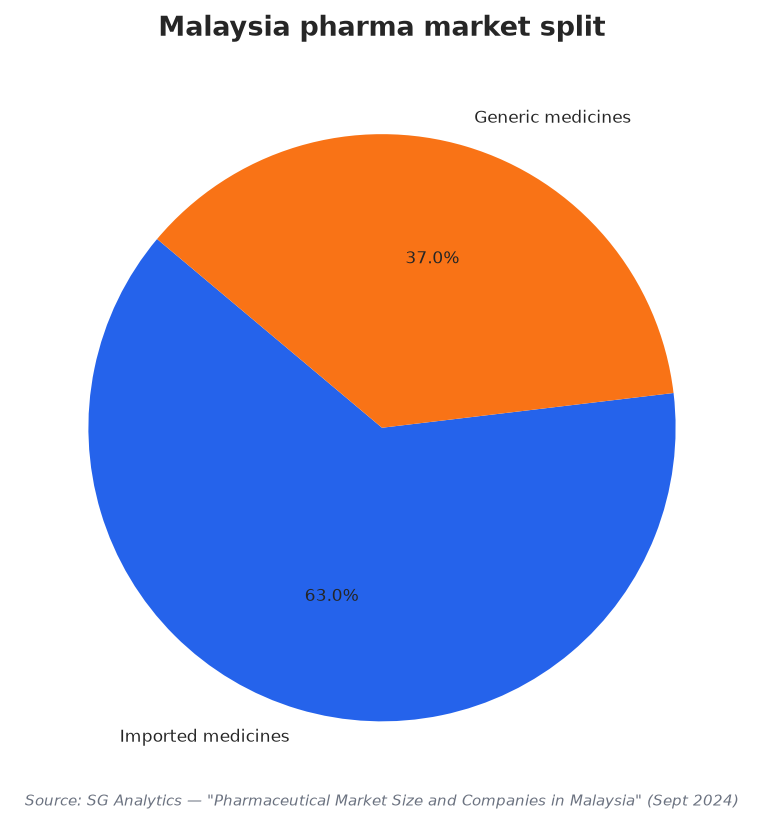
The margin discussion also connects to the structure of supply in Malaysia. Imported and generic medicines account for 63% and 37% of the pharmaceutical market by value, respectively, and local manufacturers are described as producing only generic medicines. The pharmaceutical industry is described as having grown at an average annual rate of 8% over the last decade. At the product-demand level, one market view segments oral drug solutions with metabolic/endocrine at about 28% share and tablets at around 45% share. In a system where generics are central to affordability and competition, mandatory price display can compress room for discretionary pricing in the private channel, while shifting negotiation pressure upstream to manufacturers and distributors.
At the market level, Malaysia’s pharmaceutical market has been described as approximately US$3.5–4 billion in 2026, growing around 7% annually across a population of 34 million. The private channel is also described as accounting for roughly half of pharmaceutical value, alongside 3,600+ community pharmacies, with recurring price transparency initiatives noted in that context. If mandatory price display is implemented or expanded, the most immediate effect may be on how quickly private-channel price differences become visible. Over time, that can influence brand strategies for patented versus generic portfolios, and it can push pharmacies and clinics to justify pricing using availability, counseling, and convenience rather than opacity.
What is driving recent medicine price changes in Malaysia’s private pharmacies?
How might a Malaysia medicine price display requirement affect private pharmacies?
Why does the private channel matter so much in Malaysia’s pharma pricing discussion?
How import-reliant is Malaysia’s pharmaceutical market by value?
What do retail pharmacy trends suggest about price pressure and competition?