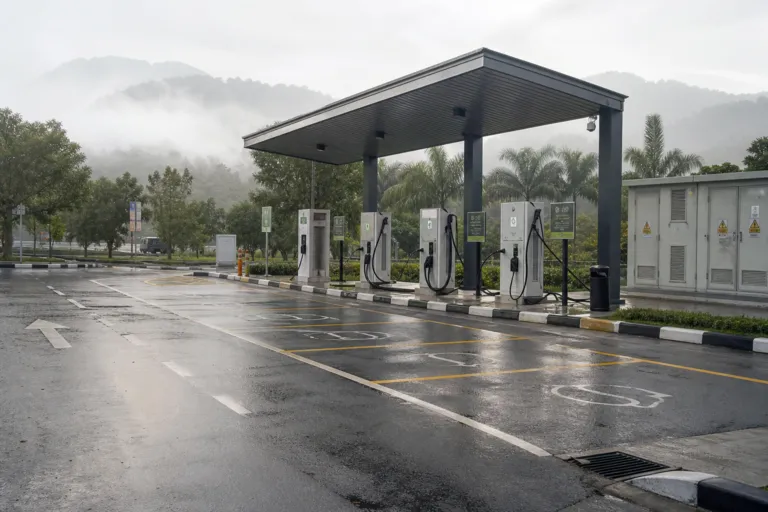
Malaysia’s charging rollout is now at a point where speed of deployment alone is not the main story. The Malaysia Automotive, Robotics and IoT Institute (MARii) said the market is shifting from chasing the number of chargers toward choosing the most suitable build pathways. Even so, the national network has reached only about half of its target, a shortfall that highlights structural obstacles in scaling. Industry voices also tie demand momentum to macro conditions. In March 2026, EV registrations reached 4,717 units and were up more than 50% year-on-year, while total registrations in the first quarter doubled compared with the same period last year.
Looking at where infrastructure exists today, the distribution is a key issue for Malaysia EV charging infrastructure planning. Penang Institute cited that more than 4,000 charging bays are concentrated in urban areas, while rural areas remain under-served. The same source notes that most existing chargers are concentrated in urban centres such as Kuala Lumpur, Selangor, and Johor, and that this contributes to “range anxiety” among potential adopters. Policy ambition has been explicit. The government set a nationwide target of 10,000 charging bays by the end of 2025, and Malaysia’s Low Carbon Mobility Blueprint (LCMB) also set a national target of 10,000 public EV chargers by 2025.
Who Is Building the Network: Utilities, GLCs, and Fast-Moving CPOs
Network expansion is being driven by a mix of government-linked companies, utility-backed operators, and private charging point operators (CPOs). ChargeSINI describes an “Agility Gap” in 2025: while government-linked and utility-backed players are expanding networks, many private operators are moving quickly to secure locations, deploy chargers, and scale infrastructure. The same source frames grid readiness as a dependency for infrastructure growth and argues that power upgrades must align with charger deployment. It also emphasizes that network performance comes from balancing charger types: DC fast charging increases turnover and enables more vehicles per day, while AC charging remains important for residential, workplace, and long-duration parking settings.
These choices matter because charging behavior is linked to location “dwell time.” Reccessary reports a quality-over-quantity pivot: AC chargers fit dwell-time locations, while DC fast chargers fit highway corridors. Operational constraints also shape siting decisions. ChargeSINI notes typical AC charging sessions can take five to eight hours, meaning a bay can stay occupied for much of the day, while DC fast charging can serve multiple vehicles across the day. On the demand side, EvGuru reported Malaysia’s EV demand surged 106% in 1H 2026 to 26,192 units, and warned that many condos, car parks, and commercial properties still have zero charging infrastructure.
The remaining gaps are therefore not only about nationwide totals, but also about access at the places people actually park. EvGuru highlights that without accessible home charging, a significant segment of potential buyers will stay on the sidelines, and buildings without charging lose tenants and residents to better-equipped alternatives. It also reports the EV share of overall TIV at 6.8%, up from below 1% five years ago, and cites a Kenanga Investment Bank projection of 10% EV market share by 2027 as local production scales up. Combined with Malaysia’s stated 10,000-bay goal and the reality of a network at about half its national target, the practical challenge is clear: deployment must expand beyond urban clusters and into homes, workplaces, and travel corridors without sacrificing reliability.
How far along is Malaysia’s charging rollout versus its target?
Where are Malaysia’s charging bays concentrated today?
Who is building Malaysia’s EV charging infrastructure network?
What EV demand signals are pressuring charging access in buildings?
Why does charger type (AC vs DC) matter for closing coverage gaps?