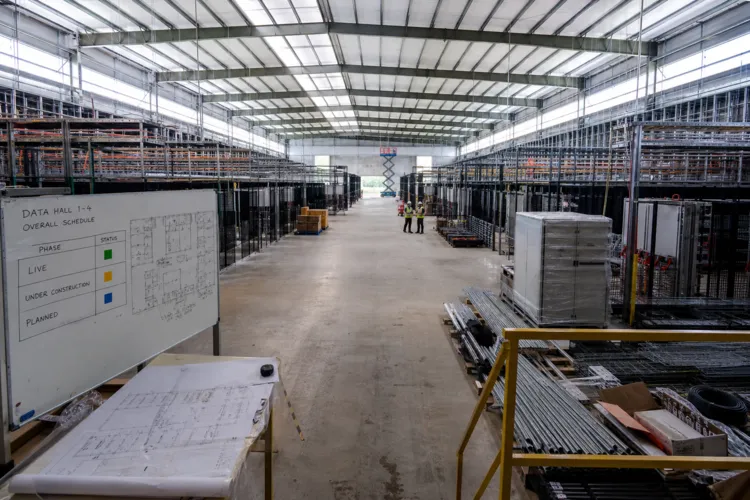

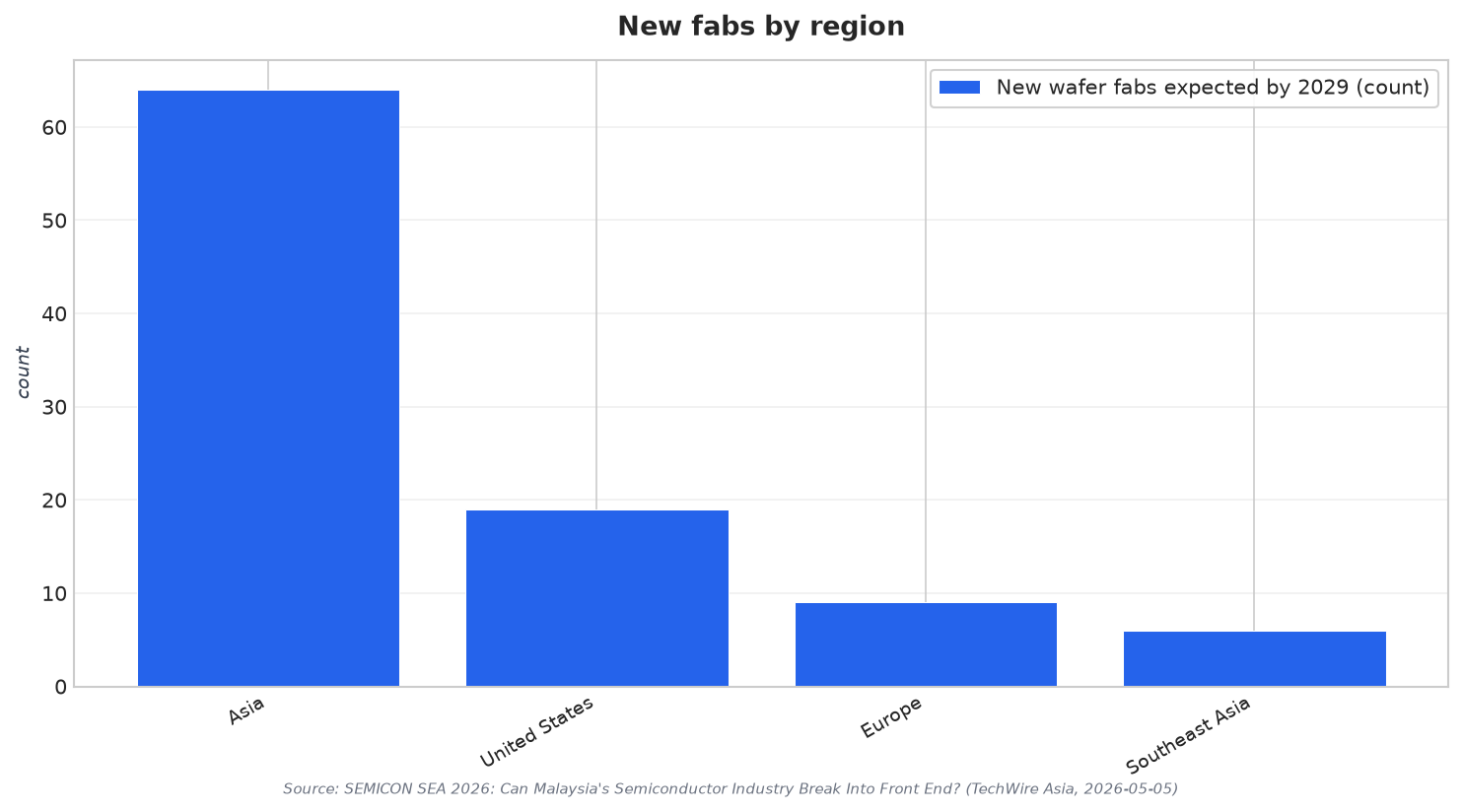
Malaysia’s ambition to move into front-end work is being discussed in public, and the context is unforgiving. At SEMICON Southeast Asia 2026, speakers pointed to a global pipeline of 89 new wafer fabrication plants expected by 2029. Roughly 64 of those are projected to be in Asia, concentrated in Taiwan, South Korea, Japan, and China. Nineteen are projected in the United States and nine in Europe. Southeast Asia’s projected six, across a region of 680 million people, shows how limited the near-term allocation is even for a region with established back-end infrastructure.
On investment signals, Malaysia can point to momentum rather than guaranteed fab wins. One report cites RM28.5 billion in E&E sector approvals last year, alongside data centre commitments tied to Johor’s digital infrastructure. It also highlights Infineon’s planned wafer fabrication expansion at Kulim Hi-Tech Park as an example of front-end related movement. Separately, a manufacturing database summary describes the National Semiconductor Strategy as a plan to attract RM500 billion in investment, with targeting that explicitly includes IC design, advanced packaging, and wafer manufacturing.
Capacity Comes First: Packaging Lines, Utilization, and What Investors Can Measure
Near-term capacity is most concrete where front-end momentum intersects with advanced packaging and wafer-level processes. A SEA Weekly report citing MIDA (February 9, 2026) states initial capacity for Chipbond’s new Batu Kawan facility is set at 10,000 wafers and 100 million WLCSP units a month, with customer qualification beginning in the first quarter of 2026. The same SEA Weekly piece describes the National Semiconductor Strategy as phased: modernise OSAT first, then move into advanced packaging, bring in higher-end equipment players, and only later chase new wafer fabs. It also cites RM1.59 billion earmarked for an Advanced Packaging Centre inside a broader RM25 billion incentive envelope (MIDA, June 20, 2024).
Value-chain math is shaping investor expectations, and it also frames why Malaysia wants more front-end capability. SEA Weekly, citing MIDA (June 20, 2024), states OSAT represents about 6% of global semiconductor value-add, while front-end fabrication accounts for 24% and IC design plus embedded software around 50%. Malaysia’s established scale is still back-end heavy: one Malaysia value-chain guide says multiple sources put Malaysia at about 13% of global chip assembly, test, and packaging output, and one source also notes Malaysia OSATs ship 13% of global chips, mostly through multinational corporation facilities located in the country. The same guide adds a reported gap: advanced techniques sit in MNC facilities, while local companies “don’t have any.”
That gap is pushing both consortium-building and market narratives around Malaysia semiconductor wafer fabrication. The value-chain guide says that at SEMICON Southeast Asia 2026, five Malaysian companies—Inari Amertron, Pentamaster, NSW Automation, SkyeChip, and startup FusionAP—launched the Malaysia Advanced Packaging Consortium (MAPC), with a stated target to capture 7% of the global advanced packaging market by 2035, starting from “zero” for local capability. Talent is a parallel constraint. A Penelitian paper stresses Malaysia still struggles with talent shortages and front-end design ecosystems compared with Taiwan, South Korea, or the U.S., and argues policy ambition must be matched with long-term capability building that includes design expertise, wafer fab investment, and R&D ecosystems.
How many new wafer fabs are expected globally by 2029, and how many are projected for Southeast Asia?
What measurable capacity has been stated for Malaysia’s new wafer-level packaging build-out?
How is Malaysia sequencing its push from OSAT into more front-end activities?
Why do investors focus on value-add when discussing Malaysia’s semiconductor roadmap?
What is shaping the outlook for Malaysia’s semiconductor wafer fabrication ambitions beyond capital spending?