

Malaysia Africa investment is becoming an increasingly important component of Malaysia's international economic relationships. Beyond trade in agricultural products and industrial materials, investment flows and maritime connectivity are creating opportunities for deeper cooperation.
ASEAN–Africa: The Next Corridor, developed by Eurogroup Consulting in collaboration with the Alliance des Patronats Francophones (APF) and the Cambodia Chamber of Commerce (CCC), examines Malaysia's role in this developing economic relationship.
Launched at REF 2026 in Phnom Penh on 14 November, the whitepaper highlights Malaysian investment activity, industrial complementarities, and the importance of logistics gateways connecting Southeast Asia with Africa.
For Malaysian companies, these developments create opportunities to explore new markets, production partnerships, and regional distribution networks.
How Significant Is Malaysia's Investment in Africa?
Malaysia has an established investment presence in African markets.
According to the Department of Statistics Malaysia, as cited in the whitepaper, Malaysia's direct investment stock in Africa stood at approximately US$8.7 billion at the end of 2024.
This represents accumulated investment holdings rather than new investment during the year.
The report also identifies Africa as Malaysia's largest destination for new outward investment in 2025, with approximately RM7 billion directed toward the continent.
Mauritius and Angola were among the important destinations.
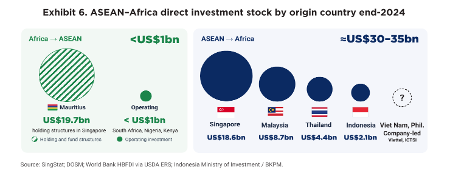
However, these figures require careful interpretation.
Some investment routed through Mauritius involves holding or financial structures rather than direct productive investment in local operating companies.
For business leaders, understanding the destination, structure, and economic purpose of investment is essential when evaluating commercial opportunities.
The ASEAN–Africa: The Next Corridor whitepaper examines these investment relationships alongside trade and industrial development.
Trade Links Connect African Resources With Malaysian Industry
Malaysia's industrial capabilities create opportunities for complementary relationships with African producers and markets.
Several sectors are particularly relevant:
- Agricultural products: Malaysian vegetable oils and food ingredients support African consumer and industrial demand.
- Mineral inputs: African manganese and other resources supply Malaysian manufacturing and processing industries.
- Manufactured goods: Electronics, chemicals, machinery, and equipment offer potential export opportunities.
- Commercial services: Finance, logistics, and distribution capabilities can support wider cross-regional business.
The whitepaper highlights manganese exports from South Africa to Malaysia as an example of established mineral supply relationships.
Such connections demonstrate how African resources can support Southeast Asian industrial production.
However, commercial opportunities must be assessed against transport costs, product specifications, customer demand, and supply reliability.
For Malaysian companies, the priority is identifying where cross-regional cooperation offers measurable advantages.
Maritime Gateways Are Strengthening Market Connectivity
Malaysia's ports play an important role in connecting Southeast Asian production centers with international markets.
Port Klang and Tanjung Pelepas are major maritime gateways supporting shipping and regional transshipment.
The whitepaper highlights the expansion of container services connecting ASEAN with African ports.
CMA CGM provides a relevant example.
In 2026, the shipping group reorganized its Asia–West Africa network around dedicated weekly services linking Singapore and Malaysia's Tanjung Pelepas with African gateways.
These include ports in Côte d'Ivoire, Ghana, Togo, Nigeria, Cameroon, and the Republic of the Congo.
The network increasingly extends beyond maritime terminals into inland African destinations.
This illustrates the importance of connecting ports with transport corridors, distribution facilities, and commercial markets.
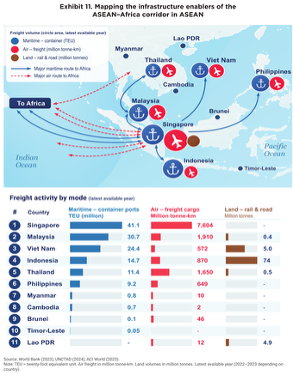
For Malaysian exporters, shipping connections can support market access, although effective distribution also requires inland logistics and reliable customs processes.
Read more about the importance of these capabilities in Malaysia's Regional Trade Intermediary Ports.
From Capital Flows to Productive Partnerships
Investment growth does not automatically translate into operational business development.
Long-term commercial value depends on whether financing supports viable production, distribution, and service activities.
Arnaud Lagesse, Group Chief Executive Officer of IBL Ltd and President of Business Mauritius, emphasizes this challenge in the whitepaper:
"The challenge is to move beyond a relationship based solely on the exchange of goods. We must connect the markets, the production capacities and the talent of the two regions."
His observation highlights the importance of linking capital with industrial capabilities and market demand.
For Malaysian companies, opportunities may arise through manufacturing partnerships, investment platforms, industrial supply chains, and logistics services.
However, different markets present different regulatory requirements, financial risks, and operating conditions.
Commercial due diligence remains essential before committing substantial investment.
Which African Opportunities Should Malaysian Companies Prioritize?
Malaysia's established industries provide several possible routes into African markets.
However, selecting the appropriate opportunity requires sector-specific analysis.
Businesses should evaluate:
- Commercial demand: Identify markets where Malaysian products and capabilities meet customer requirements.
- Supply-chain suitability: Assess sourcing, production, logistics, and distribution economics.
- Partner quality: Verify potential manufacturers, distributors, and investment counterparties.
- Investment feasibility: Review capital requirements, regulation, operating risks, and expected commercial returns.
These considerations can help companies distinguish strategic interest from opportunities with realistic implementation potential.
For executives evaluating expansion, Malaysia market research and strategic consulting can support market selection, partner assessment, and commercial feasibility.
Frequently Asked Questions
How much has Malaysia invested in Africa?
Malaysia's direct investment stock in Africa reached approximately US$8.7 billion at the end of 2024, according to the Department of Statistics Malaysia, as cited in the whitepaper. This figure represents accumulated investment holdings rather than investment made during a single year.
Why is Africa attracting Malaysian investment?
African markets offer opportunities in manufacturing, energy, infrastructure, services, and investment diversification. Malaysia has established financial and commercial relationships with several African economies. However, investment structures differ, and some capital flows involve holding companies rather than direct investment in operating businesses.
What does Malaysia trade with African countries?
Malaysia exports vegetable oils, industrial products, machinery, and manufactured goods to African markets. African producers supply mineral resources and other industrial inputs to Malaysia. These relationships connect African production capabilities with Malaysia's processing and manufacturing industries.
How do Malaysian ports connect to African markets?
Port Klang and Tanjung Pelepas connect Malaysian businesses with international shipping networks. Services linking these ports to African maritime gateways can support distribution across multiple markets. Commercial performance depends on shipping schedules, cargo demand, customs efficiency, and inland transport infrastructure.
Explore Malaysia's Investment Opportunities Across Africa
Malaysia's industrial strengths, investment relationships, and maritime connectivity provide a foundation for deeper business cooperation with African markets.
For investors and business leaders, the full whitepaper offers detailed analysis of investment flows, sector opportunities, logistics gateways, and long-term economic partnerships.