
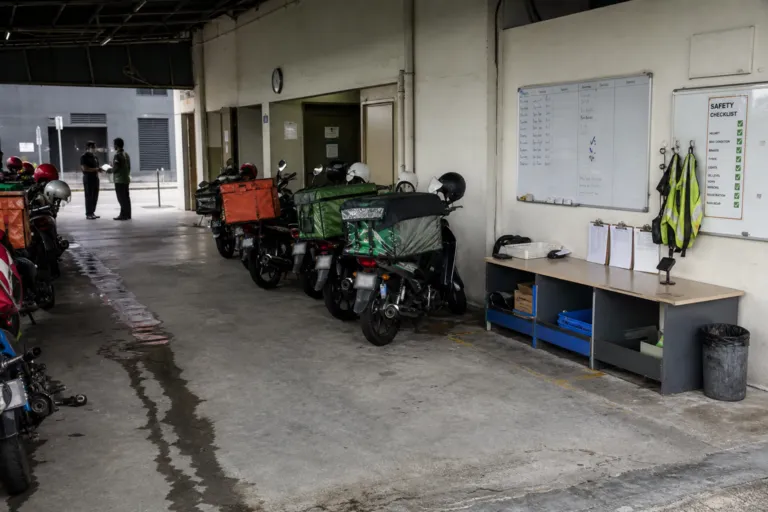
Malaysia’s transport reality is already two-wheeler heavy. As of the end of 2023, the country recorded over 13.6 million registered two-wheelers, and about 83% of households owned at least one motorcycle. Industry reports also frame Malaysia as the world’s 13th-largest motorcycle market, with motorcycles playing a central role in commuting and in city logistics. This matters for urban access. Motorcycles are already the vehicle many people have, know, and use to move through congestion, which is exactly why the conversation about motorcycle-based mobility keeps resurfacing whenever first- and last-mile pain points get worse.
But for passenger transport, the regulatory position remains the key constraint. A local industry explainer notes that current laws do not allow motorcycles to carry fare-paying passengers as a commercial ride-hailing service, and that Malaysia’s e-hailing rules were built around cars, not two-wheelers. It argues that any shift would require public debate, safety studies, and political will. In this context, Malaysia motorcycle ride-sharing is less a question of consumer awareness than of legal design. Without a framework for licensing, screening, and enforcement that fits two-wheelers, platforms have little room to build a formal market for pillion rides.
Regulatory Gaps Meet Last-Mile Demand Signals
Safety, infrastructure, and liability are repeatedly cited as the hard parts of formalizing motorcycle passenger services. The same explainer links resistance to safety concerns and describes Malaysia as having limited dedicated motorcycle lanes, higher average vehicle speeds, mixed road behavior, and diverse rider skill levels, all of which complicate standardizing safety. Insurance is another friction point. It flags unresolved questions about responsibility in crashes involving a commercial pillion rider, and notes that motorcycle liability and passenger protection can be more complex than for car e-hailing. Even as demand pressures rise, these practical issues shape what regulators will accept.
At the same time, last-mile relevance is increasing across the wider ride-hailing ecosystem. In a 2026 interview, a figure involved in designing Malaysia’s original e-hailing framework said the 20% commission cap adopted in 2019 reflected international best practices at the time and was agreed upon by platforms, drivers, and regulators. He also described e-hailing as evolving into an essential extension of Malaysia’s public transport network, providing first- and last-mile connectivity where public transport remains insufficient. Consumer research reinforces how mainstream app-based rides are: TGM Ride-Hailing Insights 2026 reports an 80% usage rate over the past year in Malaysia, with consumer choice largely shaped by price sensitivity.
Two-wheeler market momentum adds another layer to the opportunity and the policy debate. One market snapshot estimates Malaysia’s two-wheeler market reached 670 thousand units in 2025 and projects 850 thousand units by 2030, with the market’s value rising from USD 1.40 billion to USD 1.85 billion. Electrification is still early in volume terms, with electric models under 1%, yet several sources describe rapid growth from a low base. The policy question is how to regulate outcomes rather than only inputs, especially when other markets are actively tuning platform rules. For comparison, Indonesia is cited as capping platform commissions for motorcycle ride-hailing at 8% from July 1 and requiring added social protection, including workplace accident insurance and national healthcare enrolment. For Malaysia, bridging the gap would likely mean clearer licensing, insurance clarity, and enforceable safety practices before any legal two-wheeler passenger market can scale.
Why is motorcycle passenger ride-hailing not officially available in Malaysia?
How common is ride-hailing usage in Malaysia today?
What headline figures show how important motorcycles are in Malaysia?
What does Malaysia’s e-hailing regulation say about commissions?
What can Malaysia learn from other countries about motorcycle ride-hailing rules?