
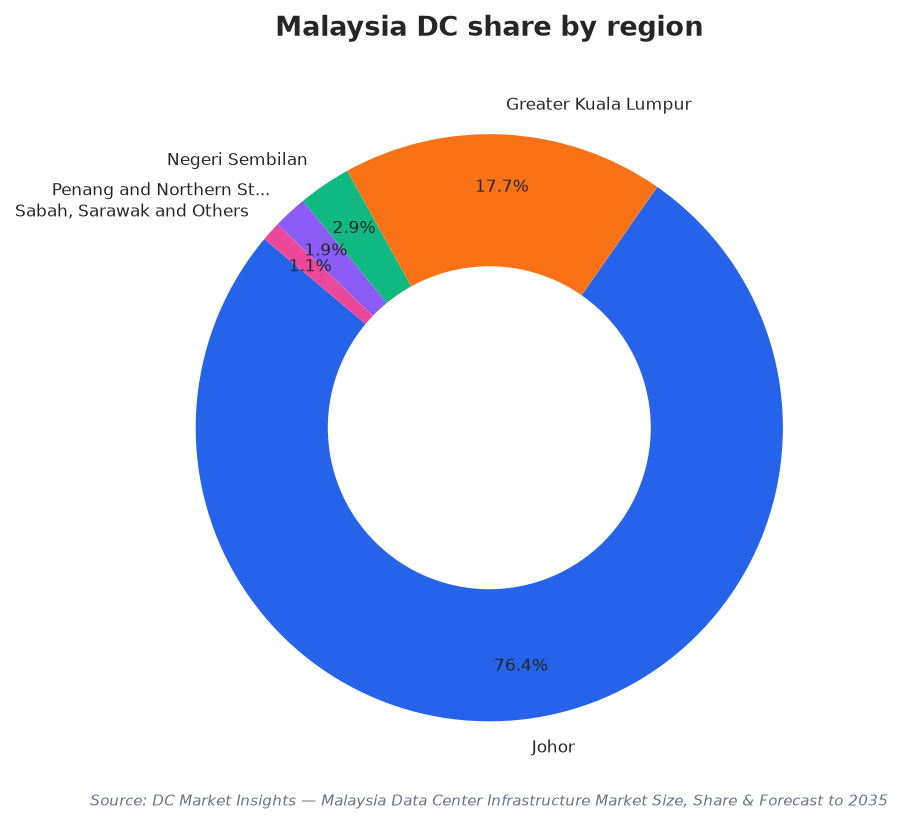
Malaysia’s data centre build-out is being shaped by a fast-expanding pipeline and a clear state-level concentration. DC Market Insights estimates the Malaysia Data Center Infrastructure market was worth USD 4,960.0 million in 2025 and is forecast to reach USD 8,840.0 million by 2035, at a 5.95% CAGR. In that same estimate, Johor accounts for 76.42% of the market, far ahead of Greater Kuala Lumpur at 17.73%. This context matters when discussing Malaysia 13MP data centre investment, because the largest infrastructure effects will likely show up first where the capital spend and site approvals are already clustered.
Operational and construction figures help anchor what is already real versus what is still prospective. DC Market Insights cites that Johor’s operational IT capacity reached 1,110 MW, with 602 MW under construction (reported by EdgeProp, sourced to Cushman and Wakefield). A separate market view from BriefAsia, citing BMI (a unit of Fitch Solutions), states Malaysia operates 125 data centre facilities with 925.6 MW of live capacity and 2.0 GW under construction. BriefAsia also reports Johor’s dominance through a combined 4.1 GW pipeline. Read together, these numbers highlight two different lenses: one focused on Johor’s delivered and in-progress IT capacity, and another describing national live and build activity while emphasizing Johor’s pipeline weight.
Johor’s AI Infrastructure Pipeline: What the Capacity Numbers Suggest
Pipeline disclosures converge around a multi-gigawatt development queue. Arizton’s openPR release says that as of November 2025, Johor’s pipeline stands at ~4.0 GW of upcoming power capacity, with 700 MW under construction and 3.3 GW in planned or announced stages. Arizton’s Malaysia data center portfolio page repeats the same split and adds that Johor represents over 70% of the country’s total power supply capacity, with clusters in Iskandar Puteri, Sedenak, and Johor Bahru. The same Arizton page notes that 61 facilities are operational today and 74 more are upcoming, and it highlights AI momentum via a roughly USD 2.36 billion AI-infrastructure agreement signed by YTL Corporation and NVIDIA in July 2025, plus Microsoft’s announcement of a new Southeast Asia 3 cloud region in Johor in November 2025.
AI workloads are also reshaping what “investment” means inside data halls. DC Market Insights states that AI halls are the fastest-growing segment at 12.61% a year, and it describes liquid cooling moving from pilot to standard in AI halls. It also provides a 2025 build receipt framework: 346.5 MW of new conventional IT capacity multiplied by USD 8.95 million per MW equals USD 3.10 billion, plus 148.5 MW of new AI halls multiplied by USD 11.50 million per MW equals USD 1.71 billion, plus USD 151.50 million of upgrades on the 505 MW installed at the start of the year. On the supply-chain side, the same source notes Vertiv announced a Johor plant for power and thermal products, including CDUs, and it reports Johor stopped approving Tier I and Tier II data centers, signaling a push toward higher-spec builds.
Constraints and “power secured” indicators will likely determine which announced projects become energised capacity. BriefAsia points to power grid bottlenecks, new tariffs applying to facilities above 100 MW, and stricter sustainability screening, while noting Johor retains dominance with 925.6 MW live capacity in its reporting. Another perspective from FYMediaCN argues investors should track “Power Secured” and “Energised Capacity,” not just announcements, and states TM and Singtel-owned Nxera are constructing an AI-ready campus scalable beyond 200 MW, with 280 MW of power already locked-in, using liquid-cooling technology designed to keep PUE at no higher than 1.30 under full load. FYMediaCN also states that from 2021 through the first half of 2026, cumulative investment attracted for data-centre-related initiatives in Malaysia stood at approximately RM385.7 billion, and that investment in Malaysia AI data centre and cloud-computing projects reached RM95.8 billion, accounting for 44% of all national approved investments.
What do the latest sources suggest about Malaysia’s 13MP data centre investment direction?
How large is Johor’s upcoming data centre pipeline, and how much is already being built?
What does DC Market Insights say about Malaysia’s data centre infrastructure market value?
What evidence is there that AI is changing the economics of data halls in Malaysia?
Which metrics are highlighted for separating announcements from real delivery in Johor?