Malaysia’s second-home conversation is shifting from broad promises to specific pathways, and Johor is at the center of that change. In 2025, Malaysia’s residential real estate market was shaped by ownership-driven sales, which made up a 76.25% revenue share, while apartments and condominiums held 70.55% of market share, according to Mordor Intelligence. In the same year, Kuala Lumpur captured 48.60% of Malaysia’s residential real estate market share, but Johor Bahru led growth at a 6.79% CAGR through 2031. Against that backdrop, the MM2H program and a Johor special-zone track connected to Forest City are becoming part of how some foreign buyers think about long-stay residency and property purchase decisions.
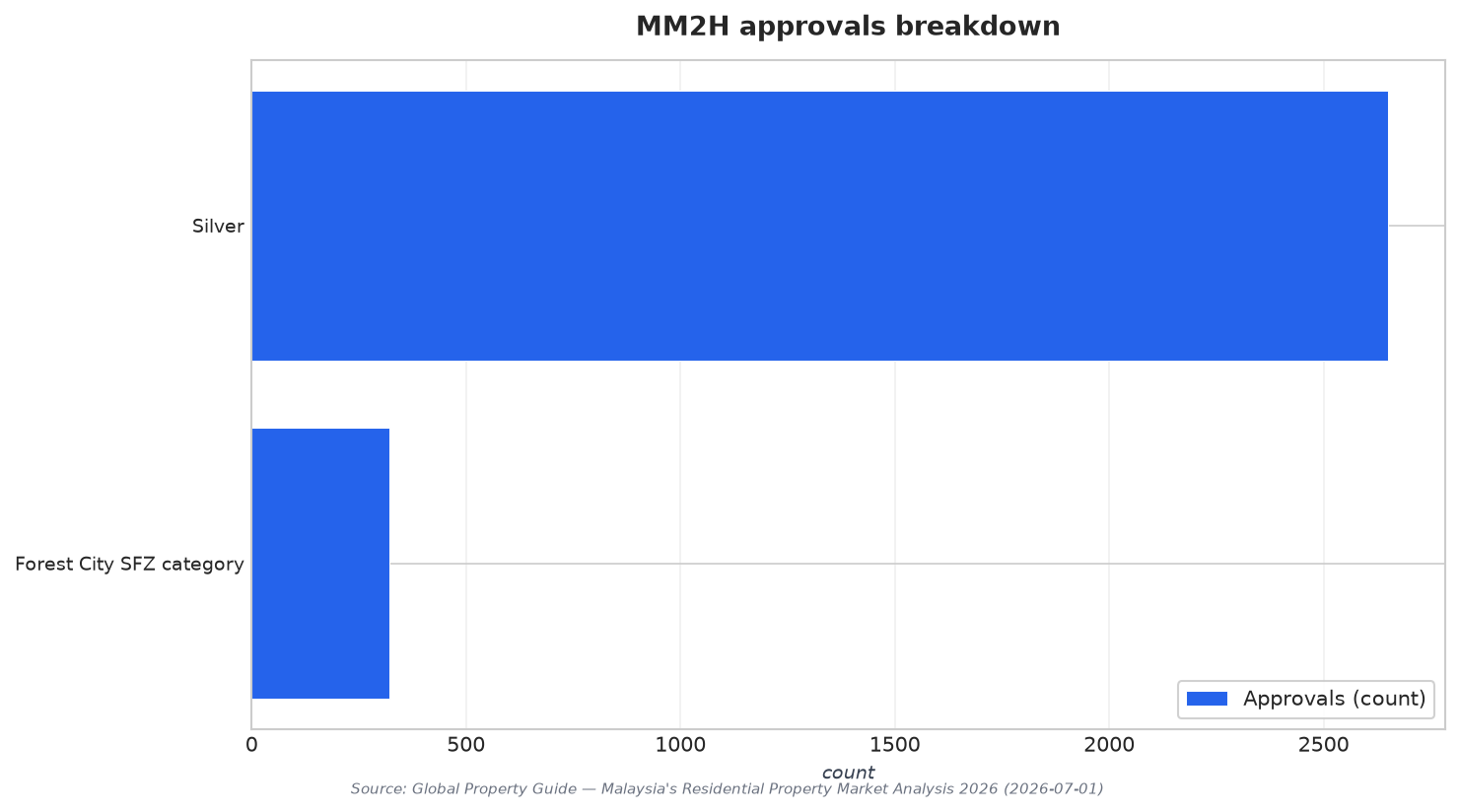
The scale of the second-home pipeline is visible in the official approvals data. MM2H approved 3,172 applications in 2025, generating an estimated MYR 3.875 billion (US$938 million) in economic value, and those approvals translated into 9,038 participants including dependents. Of the 3,172 approvals, 2,650 (83.5%) fell under the entry-level Silver category, and 322 entered through the Special Economic and Financial Zone category tied to Forest City. On the property side, 744 MM2H participants had purchased residential property in Malaysia as of 31 December 2025, with another 2,637 reported to be in the process of buying. Together, these figures show demand that is not only visa-led, but also increasingly property-linked.
Johor’s SFZ Lever: Lower Entry Points and Targeted Incentives
Forest City’s SFZ-linked MM2H route stands out because it is designed around a defined purchase-and-visa structure, rather than only a national tier. Under published OSC MM2H terms reported by Henry Butcher Malaysia Penang, national Silver requires a fixed deposit of US$150,000 for a renewable five-year visa. By contrast, the SEZ/SFZ category associated with Forest City requires US$65,000 (ages 21 to 49) or US$32,000 (aged 50 and above) and grants a renewable 10-year visa. The trade-off is direct: applicants must buy directly from developers, and the property cannot be sold for at least 10 years. This format reinforces advisers’ view that the track functions as a property-linked long-stay visa.
Costs and thresholds are also being reshaped by tax rules and by Johor’s pricing floor for foreigners. From 1 January 2026, foreign purchasers of residential property in Malaysia are subject to a flat 8% stamp duty rate on the transfer, replacing a previous fixed 4% rate. Global Property Guide illustrates the impact on a MYR 1 million (US$242,131) home: a Malaysian citizen pays roughly MYR 24,000 (US$5,811) in transfer duty on the tiered scale, while a foreign buyer pays MYR 80,000 (US$19,370). Within the Forest City SFZ, however, eligible individuals buying completed residential or commercial units directly from the developer may receive a 50% stamp duty remission on the instrument of transfer and the loan or financing agreement, subject to eligibility conditions. Johor’s general minimum threshold for foreign residential acquisition is generally RM1 million, while the SFZ MM2H-linked route generally starts at RM500,000 for qualifying purchases from the developer, with buyers advised to confirm requirements with an MM2H agent and conveyancing lawyer.
Forest City’s renewed relevance also reflects how policy and positioning can redirect attention, even for a development with a turbulent reputation. Forest City is a mixed-use project by Country Garden Pacific View Sdn Bhd, launched in 2013 and breaking ground in 2014, built on four man-made islands off the Johor coast with a 30-year masterplan. PropCashflow describes it as polarizing, framed as a RM100 billion city-of-the-future by some and as a major failure by others; it also notes Island 1 is partially developed with 30+ residential towers completed, while Islands 2 to 4 remain largely undeveloped. Today, the SFZ-linked structure is creating a clearer decision map for buyers: a defined purchase channel, a stated price starting point of RM500,000 for qualifying units, visa terms tied to that purchase, and stamp-duty treatment that differs from the national baseline. For many, that clarity is the real catalyst behind the Malaysia MM2H Forest City narrative.
How many MM2H approvals were recorded in 2025, and how many were tied to the Forest City SFZ category?
What fixed deposit and visa terms apply to the Forest City SEZ/SFZ MM2H route versus national Silver?
What is Johor’s general minimum price threshold for foreign residential purchases, and how does Forest City’s SFZ-linked route differ?
How did stamp duty change for foreign buyers in Malaysia starting 1 January 2026, and what is the SFZ incentive?