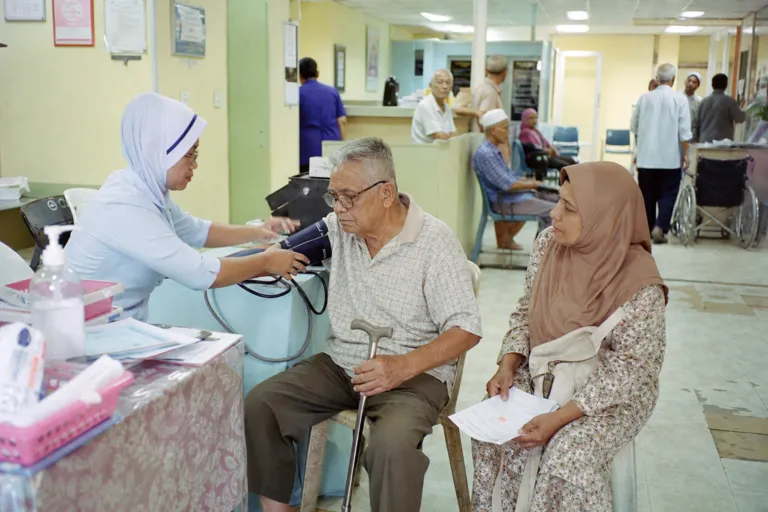
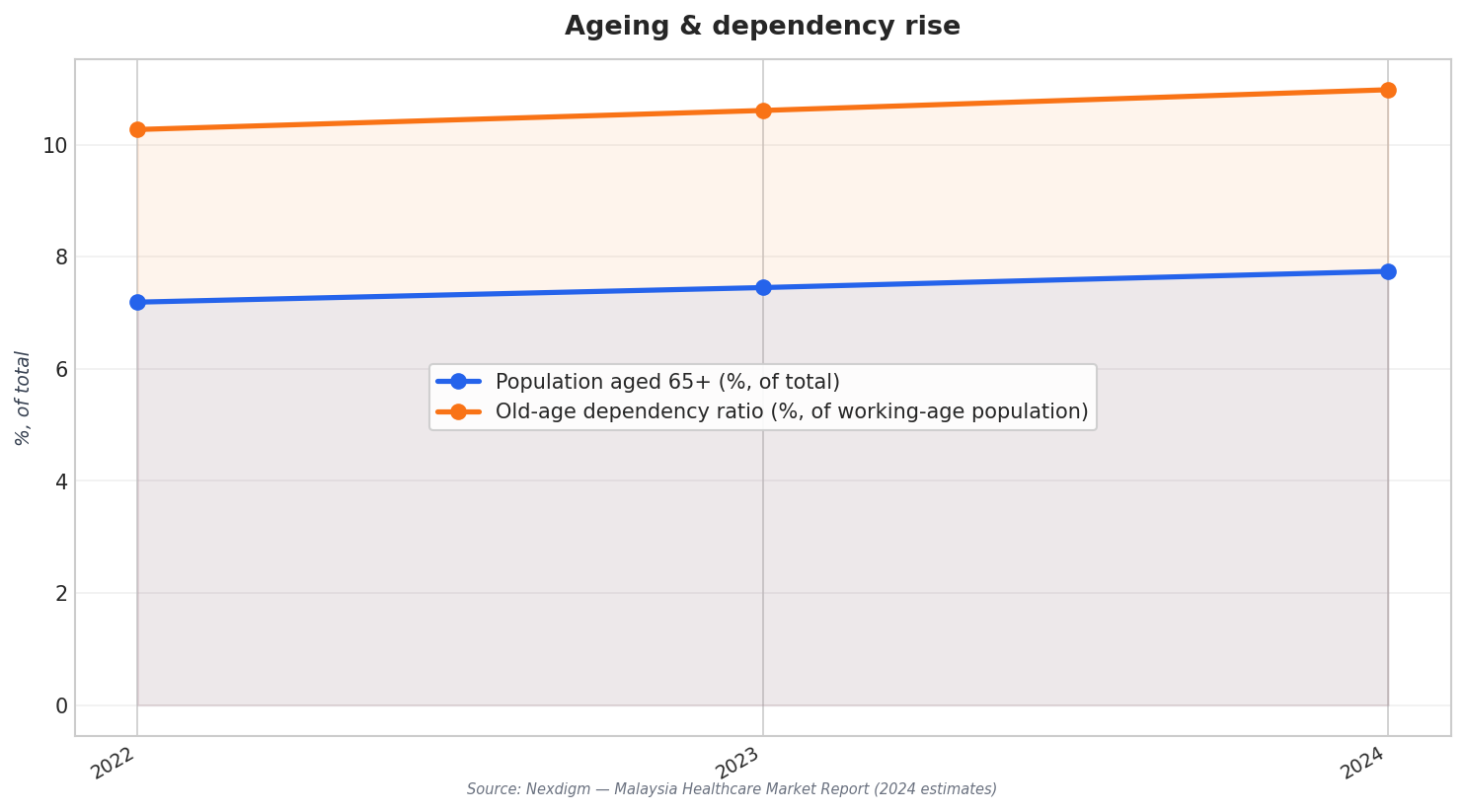
Malaysia’s demographic transition is already reshaping health service utilisation. In 2024, the population aged 65 and above constituted 7.74 per cent of the total population, up from 7.45 per cent in 2023 and 7.19 per cent in 2022, according to Nexdigm’s Malaysia Healthcare Market Report. Over the same period, the old-age dependency ratio rose to 10.98 per cent of the working-age population in 2024, compared with 10.61 per cent in 2023 and 10.27 per cent in 2022. These shifts create sustained demand for outpatient visits, inpatient admissions, and specialised care pathways that better fit older adults’ needs. This is the core of Malaysia Aging Population Healthcare Demand: more frequent care needs, more complexity, and more pressure on infrastructure.
The clinical burden behind that demand is visible in reported chronic disease patterns among older adults. CodeBlue describes a “triple burden” affecting older adults, citing high chronic disease load with diabetes at 39 per cent, hypertension at 73.1 per cent, and hypercholesterolaemia at 76 per cent. It also notes that only 14.7 per cent of older Malaysians are ageing well, pointing to gaps across health care, social support, and community infrastructure. Alongside this, the same source flags dementia as an emerging crisis that requires long-term care planning, caregiver support, and significant health care resources. Together, these patterns imply ongoing need for monitoring, medication management, and longer-term support beyond acute episodes.
Long-Term Care Capacity, Financing, and the Coverage Gap
Capacity constraints in formal elder care are stark in facility data discussed in “Ageing Population and Elder Care Practices in Malaysia: Policy Gaps and Future Directions.” The paper reports 195 registered facilities nationwide accommodating only approximately 8,000 older adults, representing less than 1 per cent of an estimated 2.2 million Malaysians aged 65 and above. It also highlights inconsistencies in standard operating procedures across elder care facilities, an acute shortage of long-term care infrastructure, and systemic over-reliance on informal family-based caregiving arrangements. The same source notes fragmentation in areas such as medication management coordination and monitoring of chronic disease progression, which can create redundancy, care gaps, and higher overall health care costs.
Financing and system sustainability are becoming central to care planning. Nexdigm values the Malaysia healthcare market at USD 27.87 billion based on 2024 estimates and says growth is propelled by government investments in public health infrastructure, increases in private health spending, and demand tied to ageing demographics. It adds that government funding dominates healthcare financing, reflecting the public system’s foundational role. Nexdigm also notes Malaysia allocates 5 per cent of its government social sector development budget to public healthcare, representing an increase of over RM 2 billion compared to prior allocations, directed toward refurbishing hospitals, constructing new facilities, expanding polyclinics, and scaling telehealth systems. Separately, “Healthy Ageing in Malaysia by 2030” stresses strengthening health insurance coverage for elderly populations to support hospitalization, specialist consultations, diagnostic tests, and long-term care services, and to reduce the burden associated with out-of-pocket health expenditure among elderly households.
Private protection products are also evolving to meet longer-term needs. Ken Research describes long-term care needs in Malaysia as most commonly addressed through medical and life insurance products that embed long-term care or disability benefits, such as riders or benefits within medical and investment-linked plans, while standalone long-term care insurance remains more niche. It also outlines benefit triggers increasingly referenced for protection solutions aimed at older Malaysians, including Activities of Daily Living-based benefits and cognitive impairment or dementia benefits, plus coverage for facility-based care and home- and community-based care. Ken Research values the Malaysia long-term care private insurance market at approximately USD 1.3 billion. On the policy horizon, a Ministry of Finance press citation reports Malaysia is projected to become an “aged nation” by 2048 when citizens aged 65 and above reach 14 per cent, and cites DOSM figures showing total population at 34.2 million in 2025, projected to rise to 36.4 million in 2030 and 38.3 million by 2035, reinforcing why long-term care, social protection, and health planning are being prioritised.
What is driving Malaysia’s ageing-related healthcare demand?
Which chronic conditions are highlighted among older adults in Malaysia?
How limited is Malaysia’s current registered elder care facility capacity?
How is the long-term care insurance market positioned in Malaysia?
What does Malaysia Aging Population Healthcare Demand mean for planning toward an aged nation?