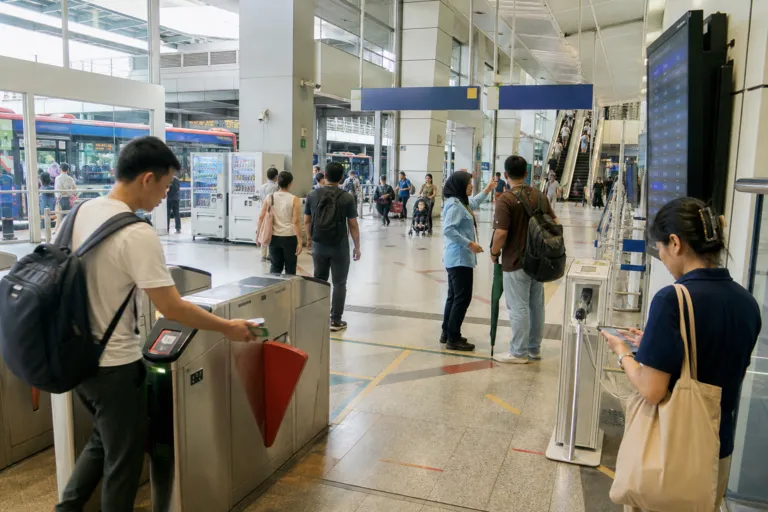
Greater Kuala Lumpur sits at the center of Malaysia’s urban mobility challenge and its opportunity. Malaysia’s urban population grew from 3 million people, or 28.4% of the total population in 1970, to 24.4 million people, or 75.1% in 2020, with much of this growth concentrated in the Greater Kuala Lumpur conurbation. The policy intent to move toward transit-oriented development is not new. Kuala Lumpur City Council recognized the need for that approach since the mid-1980s, and the KL Structure Plan of 1984 laid groundwork for urban rail systems in the metro area. Yet on-the-ground outcomes have often been shaped by road capacity expansion and auto-oriented development, which reduces the role of public transit and makes it harder to build truly multi-modal networks.
Current investment signals a shift toward connectivity and better integration across the region’s transport modes. The LRT3 line connecting Bandar Utama to Johan Setia in Klang is described as being on track to significantly boost capacity on suburban routes with high passenger demand. Rail projects also link Greater Kuala Lumpur to other corridors. Phase 1 of the East Coast Rail Link connecting Kota Bharu to Gombak is expected to be completed by the end of 2026, framed as reducing travel times between the East Coast and Klang Valley dramatically. At the same time, KTM Electric Train Service expansion, including greater frequencies and rail connections southward to Johor Bahru, is positioned to make KL Sentral a key transport hub, especially within the Tahun Melawat Malaysia 2026 (TMM2026) tourism campaign.
Turning Rail Expansion Into a Unified Smart Network
Infrastructure alone does not create an integrated urban experience. Smart mobility requires operational coordination, shared information, and rapid response. A Kuala Lumpur case study describes a smart mobility program anchored by Malaysia City Brain, the Integrated Transport Information System (ITIS), and the SMART Tunnel, and it reports measurable gains in operational performance. The study frames progress through four dimensions: data collection, connectivity, intelligent analytics, and responsiveness. This is the practical layer that can connect rail upgrades, bus services, and road management into a single user journey. It also aligns with broader global smart mobility themes, where IoT and real-time analytics are used to optimize traffic, reduce congestion, improve road safety, and support better environmental outcomes.
Electrification strengthens the “smart” proposition when it is planned as part of the network, not treated as a standalone procurement. One cited pathway is public transport electrification through Prasarana’s plans. Prasarana is planning to operate 150 electric buses in 2026, with a longer-term aim of over 1,000 new e-buses by 2030 as part of a green transport initiative to electrify 30% of its fleet by then. The same source notes an existing base of 15 e-buses on the BRT Sunway Line. It also highlights operational readiness elements such as driver training and depot readiness, and it references integration with new rail lines like the LRT Shah Alam Line. This type of sequencing links fleet changes to station access, feeder services, and system reliability.
Malaysia Smart Mobility in Kuala Lumpur also sits inside a wider market story, but local decisions should remain grounded in local needs. Global smart mobility market reporting states a market size of USD 59.32 billion in 2025 and projects USD 180.35 billion in 2033, at a CAGR of 15.3% from 2026 to 2033, while a separate global report projects a CAGR of 8.3% from 2025 to 2035. These figures are global context, not Greater Kuala Lumpur performance indicators. For Greater Kuala Lumpur, the key is to convert rail expansion, hub strengthening at KL Sentral, and ITS capabilities like Malaysia City Brain and ITIS into a single integrated network that supports walking, cycling, and public transit, rather than reinforcing automobile dependency.
What is driving the need for integrated mobility in Greater Kuala Lumpur?
Which rail projects support connectivity into and around Greater Kuala Lumpur?
How does Kuala Lumpur use intelligent transport systems to improve operations?
What are Prasarana’s electric bus plans mentioned in the sources?
What does the Malaysia Smart Mobility Kuala Lumpur topic mean in practice for commuters?