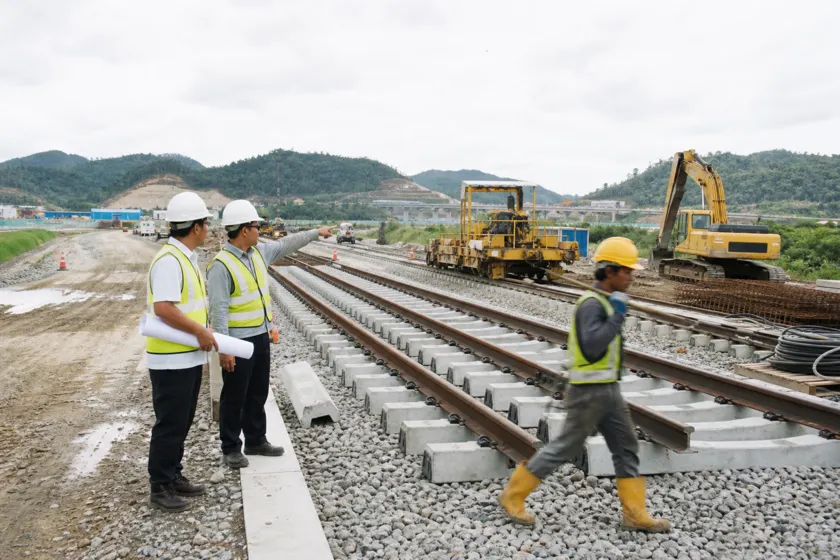
Malaysia’s East Coast Rail Link (ECRL) is an under-construction, standard-gauge, double-track rail project designed to connect Port Klang on the Straits of Malacca to Kota Bharu in northeast Peninsular Malaysia. It links the East Coast Economic Region states of Pahang, Terengganu, and Kelantan to one another and to the central region on the west coast. The line is planned to carry both passengers and freight in both directions. Construction began in August 2017, and the project has also gone through a pause-and-resume phase after Malaysia Rail Link Sdn Bhd (MRL) instructed China Communications Construction Company (CCCC) to suspend work on 3 July 2018, before the suspension was lifted following a supplementary agreement signed in April 2019.
Across 2026 reporting, the project is commonly described at 665 km, electrified, and connecting Kota Bharu in Kelantan with Port Klang on the west coast via Gombak. It is also described as the largest single Malaysian rail investment, with a project cost stated as RM 50.27 billion. Construction status is reported at 92.62% complete as of February 2026, while another 2026 report describes it as nearly 92 per cent complete and notes a preview run staged on Feb 11 using trains recently delivered from China. For readers following the East Coast Rail Link Malaysia 2026 storyline, these updates frame end-2026 as the key completion window, with operation described as starting from January the following year in another project overview.
Route, Stations, and What the Railway Is Built to Do
The ECRL’s infrastructure is described as more than track. It includes spur lines, tunnels, bridges, viaducts, depots, stations, and a signalling system. One published profile describes it as a double-track, standard-gauge (1435mm) electrified railway for mixed passenger and freight traffic, with extensive civil works including over 100 km of viaducts and 40 tunnels totaling 69 km, including a 7 km-long tunnel section between Jelebu and Semenyih. Station counts vary by alignment descriptions: one phase plan lists 22 stations along a 600.3 km route, while another project profile describes 20 stations, including 10 dedicated to passengers and 10 combined passenger-and-freight hubs.
Service expectations are also presented in practical, user-facing terms. One alignment description states that inter-city passenger trains will use 6 car-train sets for EMUs traveling at 160 km per hour, with travel time from Kota Bharu to Gombak and Port Klang described as around four and six hours respectively. Freight trains are described as using electric locomotives running at 80 km per hour. The route narrative includes a start at the Integrated Transport Terminal Gombak (ITT Gombak), presented as a future interchange with the Kelana Jaya Line and a main long-distance bus terminal, before running east through Pahang toward Kuantan, then north through Terengganu and onward toward Kelantan.
Beyond domestic movement, some sources frame the ECRL as part of broader logistics ambitions. One description positions the railway as a new land bridge connecting ports on the South China Sea with Malaysia’s west coast, with an eventual link to Thailand mentioned as a theme. Another states that the original alignment is expected to help reduce shipping time by as much as 30 hours for international freight service from China to Europe via Malaysia. Technology and construction methods are also highlighted, including a semi-automatic Chinese technology that lays 1.5 km of tracks a day with an accuracy of 10 millimeters using GPS satellites, and a separate profile citing a CCPG500A track-laying machine enabling installation rates of up to 2.5 km per day.
What does the East Coast Rail Link connect in Malaysia?
How long is the ECRL, and what is its reported cost?
How complete was the ECRL in early 2026?
What travel time and speeds are described for ECRL services?
What is the outlook for the East Coast Rail Link in Malaysia for 2026?