Malaysia’s healthcare financing is under pressure from rising costs and growing frustration over unexpected bills. Under the Ministry of Finance’s RESET strategy, the government frames reform as a whole-of-nation effort to address the root causes of medical inflation by pushing value-based healthcare, improving transparency, and strengthening access to quality care. RESET brings together MOH, MOF, Bank Negara Malaysia, insurers and takaful operators, private hospitals and clinics, doctors, and consumer groups. In parallel, public messaging around reform has highlighted rebuilding trust by making costs more predictable for patients and policyholders, especially where sudden premium shocks have damaged confidence in the current experience of private care.
One headline issue is medical inflation. A U.S. government market brief on Malaysia’s health information technology notes local media reports that medical inflation reached 15% in 2024, compared with an Asia-Pacific average of 10%. The same brief points to pressures like new medical technologies, increasing chronic diseases, and aging populations, alongside a surge in demand for healthcare services. It also states that insurance and takaful operators face claims exceeding collected premiums, creating persistent underwriting losses. These stresses set the context for Malaysia’s planned shift to structural payment reform that changes how hospitals bill and how payers reimburse.
DRG Payments and Rakan KKM: Two Levers, One Direction
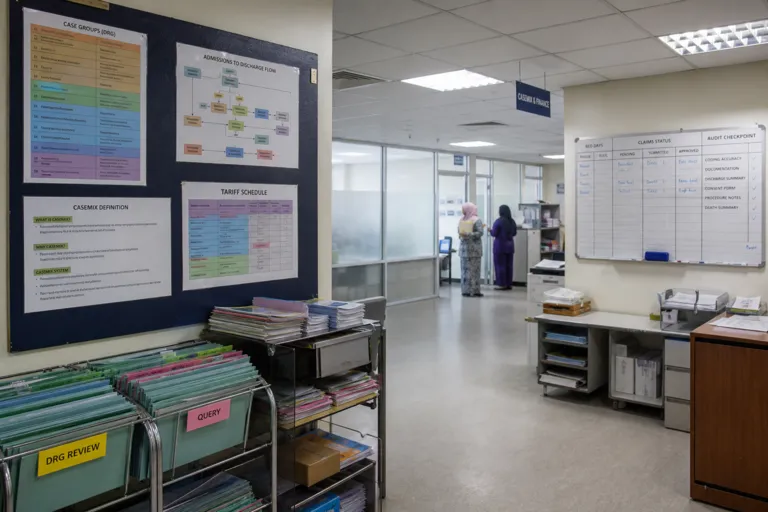
Malaysia plans to introduce Diagnosis-Related Group (DRG) payments, replacing itemised billing with case-based reimbursement. The market brief says the Malaysian Government and the healthcare industry will jointly provide US$14 million to support DRG implementation under Malaysia’s Budget 2026, and it links DRG to goals like incentivising quality outcomes over service volume, reducing unnecessary tests and procedures, and enhancing transparency in treatment costs. DRG testing is described as starting in late 2025 on simple treatments at selected public hospitals, with broader adoption across public and private hospitals expected by 2027. The Association of Private Hospitals Malaysia is cited saying accurate clinical data and a strong national electronic health record system are essential.
Rakan KKM sits beside this payment shift as a service-delivery and revenue model inside selected public hospitals. The Edge reported the “premium economy” model was slated to start at Hospital Cyberjaya in the first quarter of 2026, beginning with orthopaedic and internal medicine services. Under the model, patients can pay extra for options like personalised care, choosing their specialist, and better ward privacy, while the programme aims to generate revenue that can be reinvested into public hospitals and allow healthcare professionals to earn additional income. The official Rakan KKM site adds that prioritisation and access to emergency services will be based on clinical needs, not the ability to pay, and says revenues are used to pay the full costs of providing services, including consumables, infrastructure, healthcare teams, and administration. But CodeBlue later reported in July 2026 that Rakan KKM was still at a “finalisation” stage, with the minister citing the need to comply with the Private Healthcare Facilities and Services Act 1998 (Act 586) across licensing, governance, and management of government assets.
RESET also bundles supporting reforms that make DRG and hybrid public-private models more workable. The Medicine Price Display Initiative was gazetted on 1 May 2025 through the Price Control and Anti-Profiteering (Price Marking for Drug) Order 2025, mandating private healthcare facilities and community pharmacies to display medicine prices via price tags or a price list available to consumers. RESET also includes a revamp of MHIT: MOF says the base MHIT plan will be a standardised insurance and takaful plan intended to provide affordable, more sustainable coverage for essential private healthcare services, with launch targeted for early 2027. Together, these steps outline a Malaysia health financing reform agenda that tries to connect payment rules, transparency, digital readiness, and consumer protection into one direction: clearer prices, better data, and stronger value for patients.
What is the DRG payment reform Malaysia plans to introduce?
How much funding is allocated for Malaysia’s DRG implementation?
What services does Rakan KKM offer at launch sites?
What is mandated under the Medicine Price Display Initiative?
How do Rakan KKM and DRG fit into Malaysia’s health financing reform?