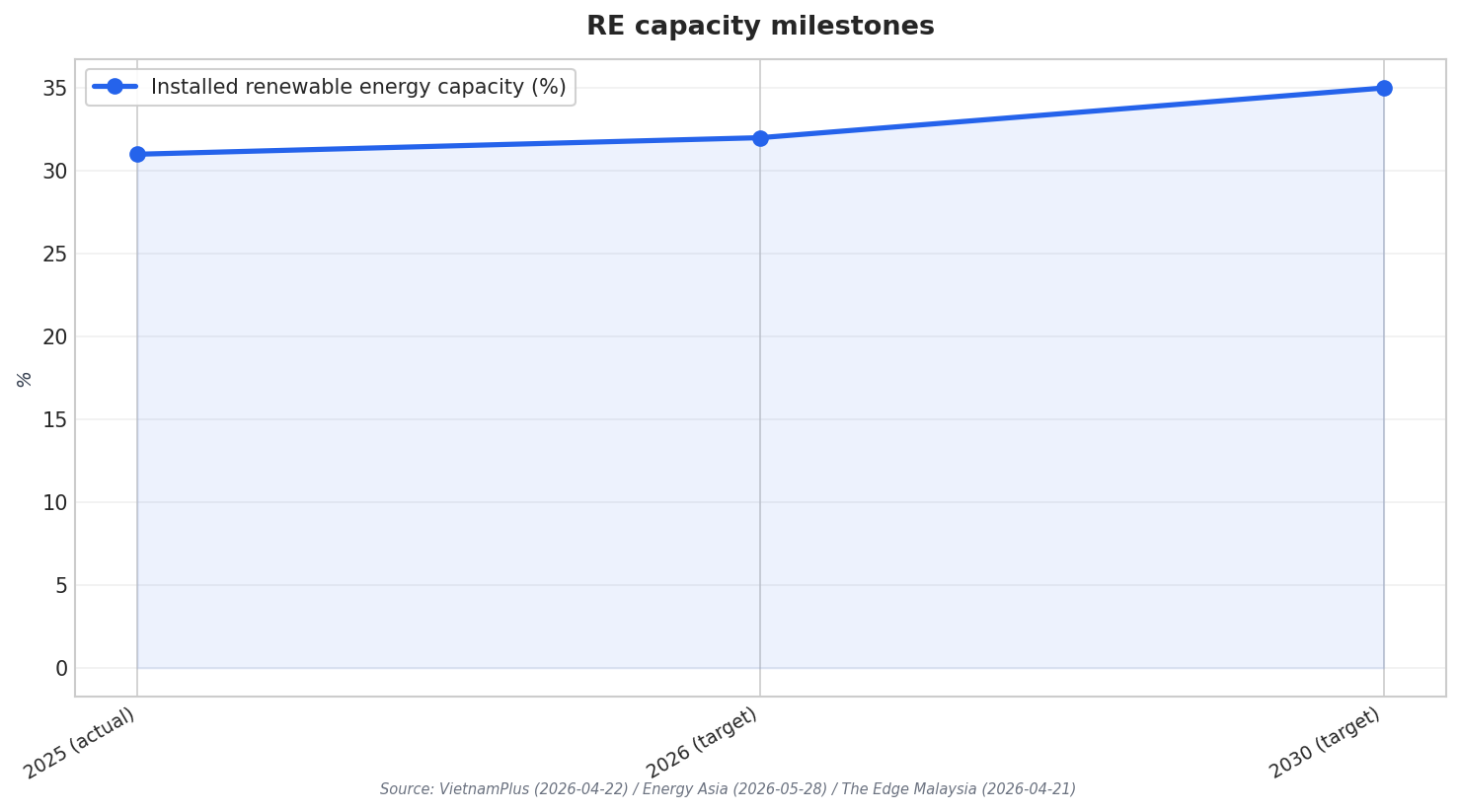
Malaysia’s energy transition is being defined by clear near-term targets and large system pressures. Deputy Prime Minister Datuk Seri Fadillah Yusof said Malaysia achieved 31% installed renewable energy (RE) capacity as of December 2025 and is committed to reaching 32% installed RE capacity in 2026. Under the National Energy Transition Roadmap (NETR), the government aims to raise installed RE capacity by one percentage point a year until it reaches 35% by 2030 or earlier. At the same time, Malaysia has pledged a 45% reduction in economy-wide carbon intensity against GDP by 2030 and committed to phasing out coal by 2044, framing renewables as a central tool for meeting these commitments.
Demand growth is a major reason the transition is urgent. The Energy Commission of Malaysia estimated 20% electricity demand growth in the next decade, driven by semiconductor manufacturing and data center industries. The same source noted that a recent influx of data center investments could increase electricity demand by up to 11 GW, described as about 40% of Peninsular Malaysia’s installed capacity. This creates a direct procurement pull for cleaner power, because these firms are looking to reduce their global carbon footprint and will need electricity generated from RE sources. In parallel, industrial demand is expected to maintain half of total consumption through 2030, with loads tilting toward semiconductor and cloud workloads that require low-carbon electricity.
Solar Scale-Up, Storage Targets, and Coal Retirement Pressures
Malaysia is leaning heavily on solar deployment while planning for grid reliability. Large-scale solar and rooftop solar projects are being accelerated, and the sixth large-scale solar project is set to be tendered in 2026. In the power market pipeline, solar is also described as being propelled by Tenaga Nasional Berhad’s 2.5 GW floating-solar roll-out and 2 GW of allocated capacity under Large-Scale Solar Round 5. To support higher solar penetration, the Malaysian government is planning to expand battery energy storage systems (BESS) to 500 MW by 2030, storing excess energy generated by solar panels for later use. On the conventional side, Malaysia plans to retire 9.1 GW of coal capacity between 2024 and 2030, while maintaining the longer-term goal of eliminating all coal plants by 2044.
Regional differences shape what “fast” looks like. Sarawak is repeatedly cited as an outlier leader: one source notes Sarawak has already achieved around 70% renewable energy and continues to expand both gas and solar development, while another states Sarawak generated 62% of electricity from renewables in 2024 and had ambitions for 15,000 MW of green energy by 2035, implying a 161% capacity increase versus 2023. By contrast, Sabah is described as still heavily reliant on costly diesel. Nationally, around 40% to 50% of Malaysia’s energy demand still relies on gas and other carbon-based sources, and Peninsular Malaysia faces challenges tied to intermittent solar output and imported gas price volatility.
Beyond generation build-out, enabling policies and adjacent solutions are also entering the picture. Malaysia passed its Carbon Capture, Utilization, and Storage (CCUS) Bill 2025 in March 2025, with Japan, South Korea, and Singapore expressing interest in exporting liquefied carbon emissions to Malaysia for sequestration in offshore oil fields nearing end of life. For the longer horizon, the NETR sets milestones of 31% renewable capacity by 2025 and 40% by 2035, while also aligning with an aspiration for 70% RE capacity by 2050. Within this context, Malaysia’s path toward the Malaysia Renewable Energy Capacity 2030 goal is being shaped by solar acceleration, storage targets, grid readiness, and the practical constraints of replacing retiring coal while meeting rising industrial demand.
What is Malaysia targeting for renewable energy capacity by 2030?
Where did Malaysia’s installed renewable energy capacity stand at the end of 2025?
How is Malaysia supporting solar variability as it adds more capacity?
How much coal capacity is scheduled to retire before 2030, and what is the long-term coal timeline?
Why is electricity demand growth a key factor in Malaysia’s energy transition plan?