Mental health demand in Malaysia is rising, and the potential economic impact is becoming harder to ignore. Zurich projects that more than 4 million people in Malaysia could be living with mental health conditions by 2030, with productivity losses reaching RM34 billion, which it frames as 1.4% of GDP. The same analysis projects a wider wellbeing impact nearing RM109 billion, and estimates that the average person living with a mental health condition could lose 62.5 days of healthy life each year by 2030. These headline figures signal a growing mismatch between the scale of need and what the system can consistently provide.
That mismatch shows up in how care is financed and who carries the burden. Insurance Asia, reporting on Zurich’s six-market study, projects that in Malaysia 42% of treatment costs could be paid directly by patients by 2030. It also projects families and caregivers could provide more than 123 million hours of unpaid mental health-related care by 2030. Total mental health-related expenditure is estimated to rise to nearly RM3 billion by 2030, described as around 0.1% of GDP. When formal coverage struggles to respond early, care shifts toward households and workplaces, increasing financial strain and delays in seeking help.
Workforce Strain and Primary Care Continuity Risks
Workforce capacity is a central constraint for Malaysia’s mental health services, especially in primary care where continuity matters for early support. CodeBlue reports that in 2020 the government appointed 200 Psychology Officers (Counselling) on a Contract for Service basis, deployed across State Health Departments, District Health Offices, and predominantly public health clinics. Over the past six years, these services annually reached more than 40,000 patients, delivered about 90,000 individual counselling sessions, and implemented more than 2,500 mental health programmes. However, the reliance on short-term contracts and the risk of non-renewal are flagged as structural vulnerabilities that could disrupt access as August 2026 approaches.
System design issues also limit reach. A Springer Nature article notes major constraints in Malaysia’s delivery, including specialist workforce shortages, uneven geographic coverage, and fragmented responsibilities across sectors. It adds that services remain concentrated in hospitals, with limited integration into primary care and community settings, restricting responsiveness for rural and marginalised communities where preventive and community-based services are still underdeveloped. CodeBlue also references WHO Mental Health Atlas benchmarks that emphasize integrated primary care, including pharmacological and psychological interventions, with a target of at least 75% of facilities providing such services, while noting Malaysia has made progress but faces sustainability questions.
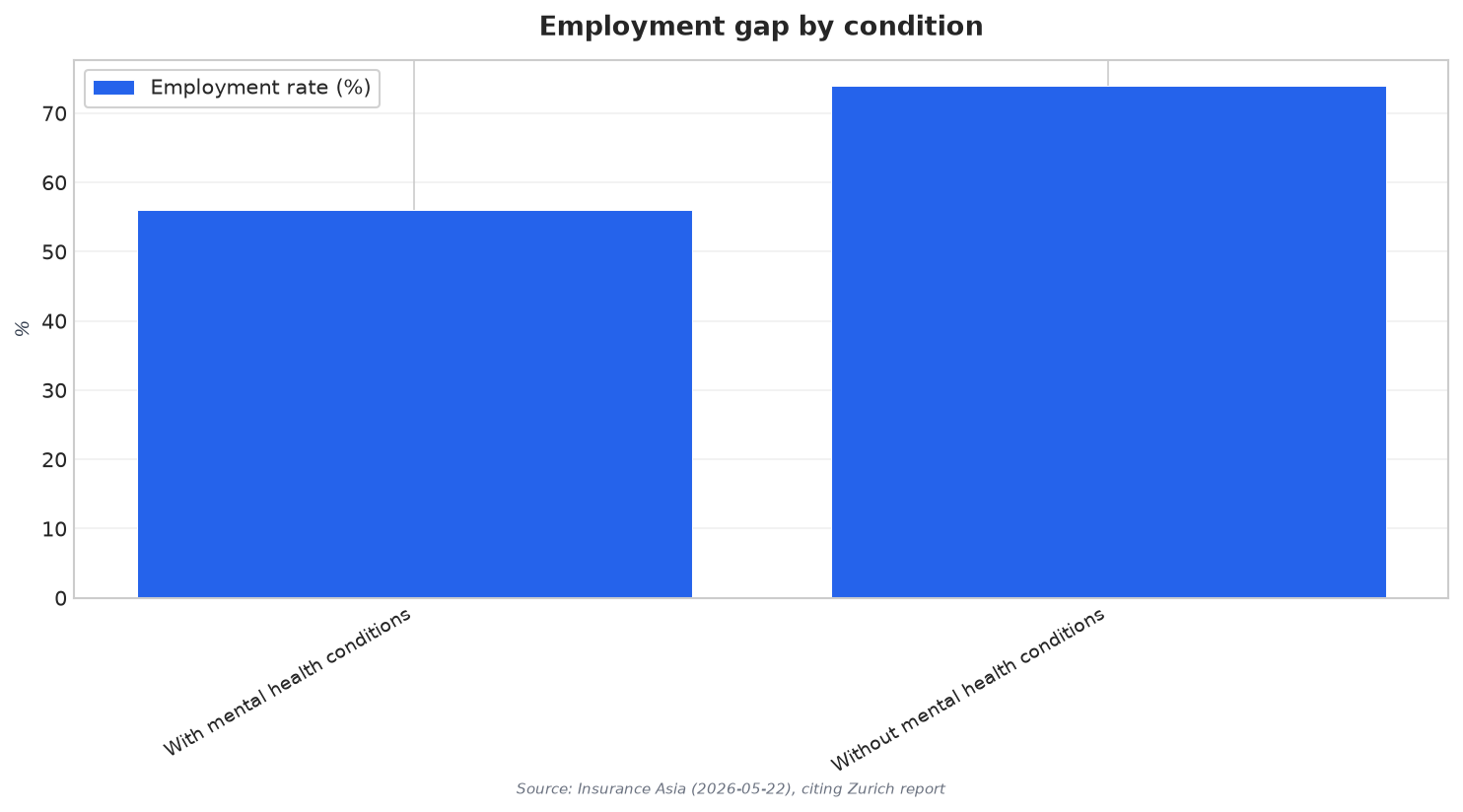
Demand pressure is visible in population indicators and in the labour market. CodeBlue cites NHMS 2023 estimates that about one million Malaysians aged 16 and above are experiencing depressive symptoms, described as double the prevalence reported in 2019, with a substantial proportion reporting suicidal ideation. Insurance Asia reports Zurich’s estimate that Malaysians with mental health conditions are 18% less likely to be employed, with employment rates of 56% compared with 74% among those without such conditions. KR Institute notes WHO’s general recommendation of one psychiatrist per 10,000 population, and that Malaysia’s psychiatrist ratio is better than Thailand and Myanmar but still lags behind Singapore and Brunei, with understaffing linked to longer waits and lower quality of care.
What is driving the care gap in Malaysia’s mental health services?
How large could Malaysia’s mental health burden be by 2030?
How much of mental health treatment costs may be paid out of pocket in Malaysia?
What do we know about counselling capacity in primary care settings?
What does the evidence say about work and mental health outcomes in Malaysia?