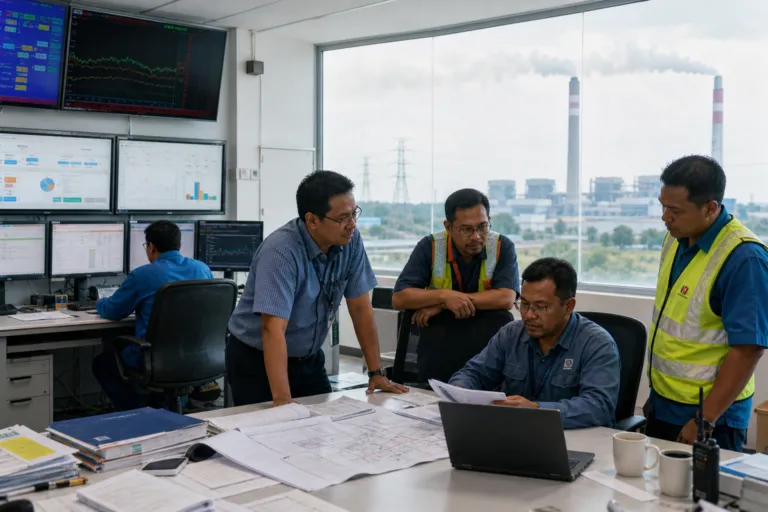
Malaysia’s coal exit has shifted from broad ambition to a time-bound agenda. The government has a national commitment not to build any new coal-fired power plants, and in 2024 set a target to completely transition away from coal by 2044. Multiple sources also describe an interim step: reducing coal power plants by half by 2035, ahead of full retirement by 2044. Taken together, this frames the Malaysia Coal Phase-Out Plan as a long, managed runway rather than a sudden shutdown, with policy intent now needing practical delivery across the power system.
Progress is happening, but it is taking place in a system where coal still matters for day-to-day supply. A U.S. government market-intelligence note says Malaysia’s power generation mix today is dominated by coal and that the country has been ramping up coal-fired power to meet rising demand. The same source adds that Malaysia has limited coal reserves and relies heavily on imports, primarily from Indonesia and Australia. It also reports coal imports reached a record 20.9 million metric tons in the first half of 2025, linking demand growth to the expansion of data center projects.
Progress Is Measurable, but the Hard Part Is System Design
Planning for a coal exit is also increasingly about identifying which assets matter most and what it costs to reduce emissions. TransitionZero’s analysis highlights a concentrated opportunity: five assets are projected to contribute 62% of cumulative emissions from Malaysia’s coal fleet between now and 2044. It provides an abatement cost benchmark averaging USD 18 per tCO₂, with a range of USD 10 to USD 26 per tCO₂ depending on the asset. The same work estimates a 2040 coal phase-out could avoid 80 million tonnes of CO₂ at a cost of USD 1.43 billion, offering a scenario for stress-testing earlier action.
The core challenge is keeping electricity reliable and affordable while coal exits. A World Economic Forum report flags the need to stabilize a renewables-led system as coal retires, initially with gas until balancing resources come online through the ASEAN Power Grid and potentially nuclear. That report also points to a broader policy direction: a goal to reach 70% renewables by 2050. It proposes practical tools, including a National Coal Site Repurposing Framework aimed at repowering retired coal sites with solar and battery storage, and it notes these insights emerged from an eight-month structured dialogue with Malaysia’s Ministry of Energy Transition and Water Transformation, supported by KPMG.
Execution risks extend beyond technology choices into contracts, finance, and operational flexibility. A technical report on coal transition notes it explores the economic and financial considerations necessary to enable coal flexibility and warns there are significant challenges and risks with implementing it. The same document estimates the average remaining lifespan of coal PPAs is approximately 17.5 years and provides a separate figure of 8.8 years in Malaysia. Against this backdrop, the World Economic Forum argues success depends on sustained action across government, industry, financiers, and regional partners, plus accelerated renewables deployment, grid and flexibility investment, and deeper regional cooperation through the ASEAN Power Grid.
What does Malaysia’s coal phase-out target timeline look like through 2044?
How does the Malaysia Coal Phase-Out Plan connect to coal imports today?
What do the sources say about the cost of earlier coal retirement?
Which assets should Malaysia prioritize to cut coal emissions through 2044?
What grid and system challenges are highlighted as coal exits?