
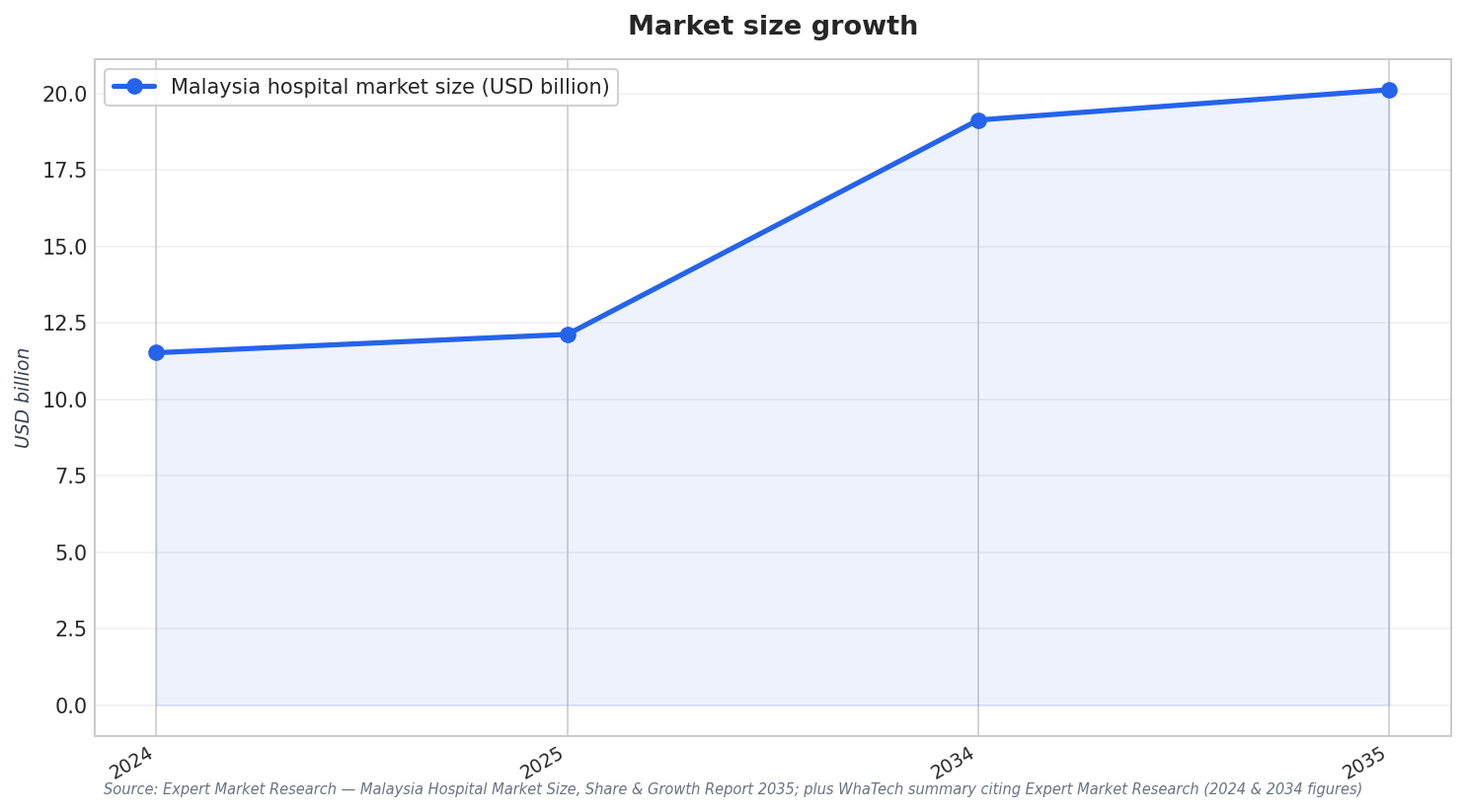
Malaysia’s hospital market continues to expand, and private providers are a key part of that shift. Expert Market Research valued the Malaysia hospital market at USD 12.12 billion in 2025 and anticipates a 5.20% CAGR during 2026–2035, reaching USD 20.12 billion by 2035. Other forecasts also describe steady growth from a USD 11.52 billion base in 2024 toward an estimated USD 19.13 billion by 2034 at a 5.20% CAGR. Across these outlooks, demand is linked to an aging population, chronic diseases, and rising expectations for higher-quality, more personalised services.
Policy and patient pull factors both matter in the Malaysia Private Hospital Sector. Expert Market Research notes that demand for personalised services and medical tourism has driven Malaysian policies to establish more private hospitals, supporting broader market growth. Medical tourism is also discussed through service-led differentiation, including cardiovascular care supported by the presence of Malaysia’s National Heart Institute, which is described as enabling treatment for different cardiovascular problems and contributing to increased medical tourism into the country, especially from the Asia Pacific region. This creates incentives for providers to add capacity and upgrade clinical offerings where demand is strongest.
What Private Hospital Expansion Looks Like on the Ground
Recent moves show how private groups are extending reach and consolidating networks. In November 2024, IHH Healthcare expanded its presence in Malaysia by acquiring Island Hospital in Penang, a step positioned to enhance healthcare access in Northern Malaysia and elevate clinical services through integration. Technology upgrades are also becoming a visible part of the competitive playbook. In November 2024, Mahkota Medical Centre (MMC) launched Malaysia’s first Next-Gen Smart Ward, described as featuring IoT-driven devices and real-time patient monitoring systems. These steps align with the broader shift toward digital healthcare solutions and patient-centric service models.
Specialty services are another driver of private growth, particularly where Malaysia is marketed as a regional care option. Expert Market Research reports that rising demand for in-vitro fertilisation (IVF) treatments is contributing to private sector expansion, and cites IVF success rates of 55–60%. The same sources frame this capability as supportive of medical tourism, attracting patients from across the region. Segment dynamics reinforce why private providers invest in facilities and service breadth. The report forecasts private hospitals to dominate the market by ownership, supported by advanced medical technology, superior infrastructure, and personalised care.
Capacity and location choices also shape how expansion is executed. The 100–500 bed category is projected to dominate Malaysia’s hospital market, reflecting a balance between affordability and service capacity in urban and semi-urban areas. On geographic concentration, Nexdigm highlights Klang Valley and Penang as leading regions due to clusters of accredited hospitals, advanced medical infrastructure, international patient access, and strong private healthcare ecosystems. Meanwhile, Nexdigm also lists consolidation of hospital groups, bundled health and wellness packages, and AI and remote monitoring integration as key trends, aligning with a market where scale, service design, and digital capability increasingly influence growth paths.
What is the growth outlook for Malaysia’s hospital market tied to private expansion?
What recent deal signals consolidation in Malaysia’s private hospital landscape?
How is digital technology showing up in private hospital expansion plans?
Why is IVF demand important for private providers and medical tourism?
What is changing in the Malaysia Private Hospital Sector as it expands?