Autonomous and connected mobility depends on more than vehicles. It needs reliable infrastructure, strong connectivity, and a digital economy that can support real-time data and fleet operations. In Malaysia, 2026 is framed as a milestone year where technology and policy converge to make mobility more efficient, greener, safer, and more connected. On the physical side, rail and road upgrades are highlighted as shaping how Malaysians travel locally and across regions. On the digital side, Malaysia’s 5G coverage is reported at 82.4% of the population, supporting lower-latency cloud and edge workloads that matter for connected transport services.
Large transport projects can change the baseline for connected services because they concentrate demand around hubs and corridors. The LRT3 line connecting Bandar Utama to Johan Setia in Klang is described as being on track to boost capacity on suburban routes with high passenger demand. The East Coast Rail Link (ECRL) Phase 1, connecting Kota Bharu to Gombak, is expected to be completed by the end of 2026, with the goal of reducing travel times between the East Coast and Klang Valley dramatically. KTM Electric Train Service (ETS) expansion, including greater frequencies and connections southward to Johor Bahru, also positions KL Sentral as a key transport hub for domestic and international travellers, including the Tahun Melawat Malaysia 2026 (TMM2026) campaign.
Connected Mobility Needs a Digital Backbone, Not Just Vehicles
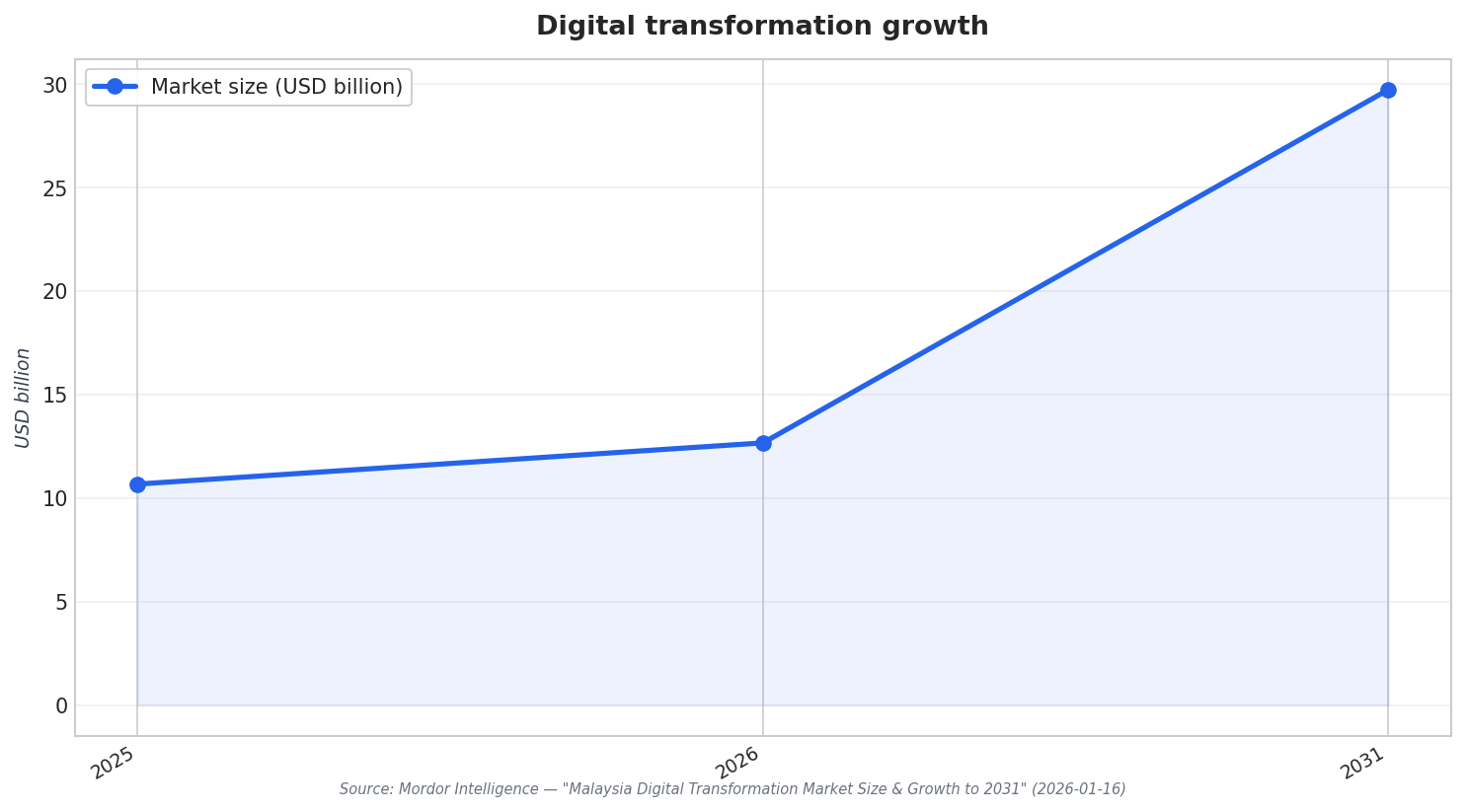
Malaysia’s digital transformation market provides context for how fast the enabling layers are scaling. It was valued at USD 10.68 billion in 2025 and is estimated to grow from USD 12.67 billion in 2026 to USD 29.74 billion by 2031, at a CAGR of 18.62% for 2026–2031. Cloud solutions accounted for 70.02% of market size in 2025, while Cloud and Edge Computing led with 57.93% market share in 2025. This matters for connected mobility because fleet monitoring, mapping updates, and vehicle-to-everything style services rely on cloud and edge capacity to process real-time streams safely and at scale.
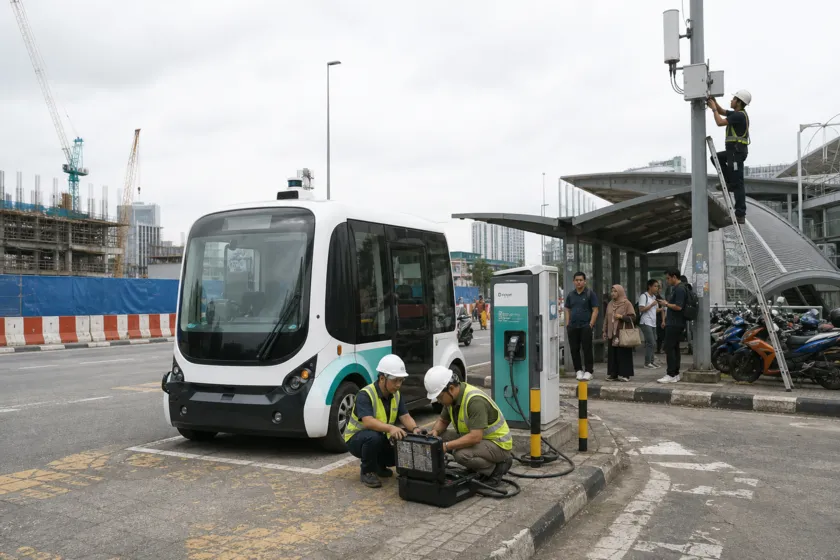
Electrification is another practical step toward modern mobility because it forces upgrades in depots, charging routines, and fleet management. In Malaysia, Prasarana is planning to operate 150 electric buses in 2026, and the same roadmap cites a target of over 1,000 new e-buses by 2030 as part of an initiative to electrify 30% of its fleet by then. The plan also references driver training and depot readiness, which are operational foundations that connected and automated fleets typically need. The existing 15 electric buses on the BRT Sunway Line are described as a starting foundation for this transition.
For Autonomous Vehicles Malaysia, the immediate story is readiness, not a single rollout date. Industry adoption signals are forming: as of 2025, nearly 78% of manufacturers have adopted AI for autonomous driving, smart factories, and production lines, indicating that capability-building is already underway in the wider automotive ecosystem. Globally, the autonomous vehicle market is estimated at USD 68.09 billion in 2024 and is projected to reach USD 214.32 billion by 2030, at a 19.9% CAGR from 2025 to 2030, showing the pace of international investment. Malaysia’s path sits at the intersection of physical upgrades, a fast-growing digital market, and electrified fleets that can act as early platforms for connected operations.
What is changing in Malaysia’s mobility landscape in 2026?
Which infrastructure projects support more connected travel across Malaysia?
How does 5G coverage relate to connected mobility in Malaysia?
What are Malaysia’s near-term plans for electric buses?
How ready is the ecosystem for autonomous vehicles in Malaysia?