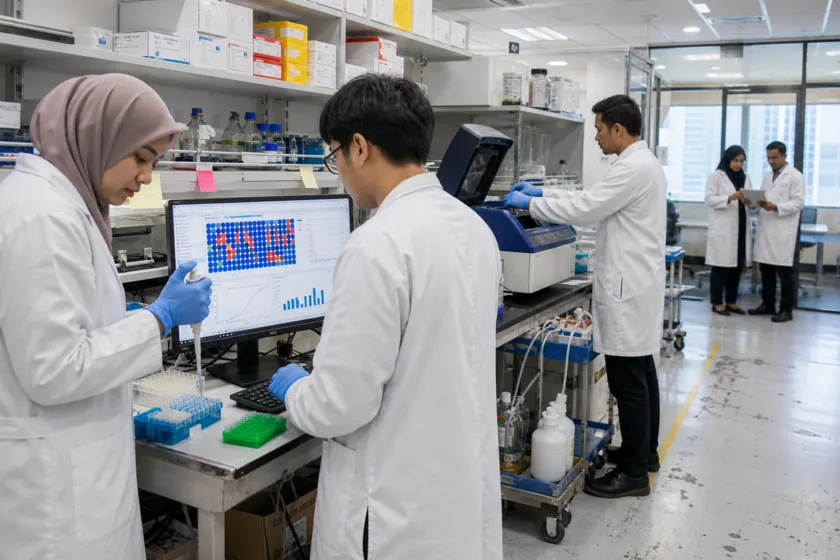
Malaysia’s life sciences ecosystem is being pulled forward by demand for advanced healthcare solutions, drug discovery platforms, and biotechnological innovation. Reported growth drivers in Malaysia include stronger investment across genomics, proteomics, clinical diagnostics, and regenerative medicine, alongside wider use of AI, big data analytics, and cloud computing to improve R&D efficiency in pharmaceutical and biotechnology pipelines. The country’s market narrative also includes rising partnerships among academic institutions, government bodies, and global pharmaceutical companies, aimed at accelerating knowledge transfer and commercialization. In parallel, a healthcare burden linked to chronic and infectious diseases is driving adoption of advanced tools for diagnostics and treatment development.
On market sizing, one forecast projects the Malaysia Life Science Market to grow from USD 87.5 billion in 2025 to USD 162.3 billion by 2031, at a CAGR of 10.8% across the forecast period. That same outlook ties growth to biotechnology-driven therapies, rising healthcare expenditures, and advances in scientific research infrastructure, with momentum supported by public-private investment and clinical trial expansion. It also notes that Malaysia is positioned to strengthen its role in the global life sciences ecosystem through biotechnology, pharmaceutical activity, and academic collaborations. This local context fits into broader global trends in biotech, including growth expectations for the global biotechnology market from USD 935.35 billion in 2025 to nearly USD 2181.5 billion by 2032 (CAGR 12.86%).
What Is Powering Malaysia’s Commercialization Path
Commercialization depends on more than discovery, and Malaysia’s outlook highlights multiple “bridge” capabilities. Government incentives, grants, and policy frameworks are cited as encouraging innovation while strengthening local manufacturing capabilities. The market story also points to a growing focus on personalized and precision medicine, which is reshaping healthcare delivery models and widening life sciences applications in the country. Another practical lever is the expanding role of contract research organizations (CROs) and contract development and manufacturing organizations (CDMOs) in Malaysia, described as critical to global supply chains. Taken together, these elements define a pathway where research output can move into clinical, manufacturing, and export-linked workflows.
Technology adoption is a recurring theme across life sciences globally, and the same digital shift shows up in Malaysia’s growth drivers through AI, big data, and cloud computing. For context, one global life sciences report states that 52% of diagnostic labs implement AI-based imaging tools, improving diagnostic accuracy by 35%, while 49% of organizations adopt point-of-care testing solutions, reducing diagnosis time by 28%. The report also cites digital pathology adoption at 46%, enhancing analysis efficiency by 31%, and research outsourcing increasing by 41%, improving cost efficiency by 26%. These figures are global, but they illustrate why Malaysia’s emphasis on digital R&D infrastructure and outsourcing-linked models can matter when building competitive discovery and development pipelines.
Zooming out, additional benchmarks help frame where opportunity may sit for the Malaysia Biotech Industry as it scales. A global biotechnology report estimates the market at USD 1.85 trillion in 2025 with an expected CAGR of 13.5% during 2026–2034, and it notes that DNA sequencing led with 38.75% share in 2025. The same source says North America accounted for 42.30% of market share in 2025, while Asia Pacific is expected to witness a CAGR of 10.85%. These are not Malaysia-specific results, but they reinforce why capabilities such as sequencing, AI-enabled discovery, and outsourced development services can be strategically important as Malaysia builds a stronger role in regional and global life sciences value chains.
What is the growth forecast for Malaysia’s life science market?
What is driving R&D efficiency gains in Malaysia’s life sciences sector?
How do CROs and CDMOs fit into Malaysia’s biotech and life sciences boom?
How is the Malaysia Biotech Industry connected to global market momentum?
What global data points suggest why AI and diagnostics matter to life sciences growth?