Malaysia’s National Energy Transition Roadmap (NETR) was unveiled on 27 July 2023 as a government-led framework to facilitate the energy transition across six pillars: energy efficiency, renewable energy, hydrogen, bioenergy, green mobility, and carbon capture, utilisation and storage (CCUS). The roadmap is positioned as a strategic economic shift, not only a power-sector plan. One legal commentary notes that in 2018 the energy sector contributed approximately 28% of Malaysia’s GDP and 25% of total employment, underscoring why the transition is framed around competitiveness and resilience. NETR Part 2 is targeted to address the low-carbon pathway, energy mix, emission target reduction for the energy sector, and the enablers needed for the transition.
Phase 1 already signals scale and near-term execution. The IEA policy summary says Phase 1 has attracted RM25 billion of investments from the public and private sector, supported by a government commitment of RM2 billion in seed funding. A separate NETR Part 1 document likewise says the implementation of 10 flagship projects and initiatives is expected to generate investment of approximately more than RM25 billion through a combination of private and public funding. These early commitments matter for developers and corporate buyers because they indicate a pipeline, not just intent. The same Part 1 material also references Bursa Malaysia’s voluntary carbon market, the Bursa Carbon Exchange (BCX), as a platform for voluntary purchases of carbon credits from climate-friendly projects and solutions.
What the NETR Targets and Projects Mean in Practice
Several NETR milestones and projects recur across sources. Mordor Intelligence states the NETR sets targets of 31% renewable energy by 2025 and 40% by 2035, and links implementation to grid modernization. On projects, the IEA lists floating hydro solar power at 2500 MW on a TNB hydro dam reservoir, residential solar power via construction of 4.5 MW residential rooftop solar power plants, and hydrogen via three integrated hydrogen production plants in Sarawak. It also lists eco-friendly mobility initiatives, including 10,000 EV charging stations and electrification of public transport, plus a Petronas-led CCUS catalyst project in the high-CO2 Kasawari and Lang Lebah gas fields. In parallel, one power-market analysis also ties the roadmap to TNB’s 2.5 GW floating-solar roll-out and notes 2 GW allocated under Large-Scale Solar Round 5 in 2024.
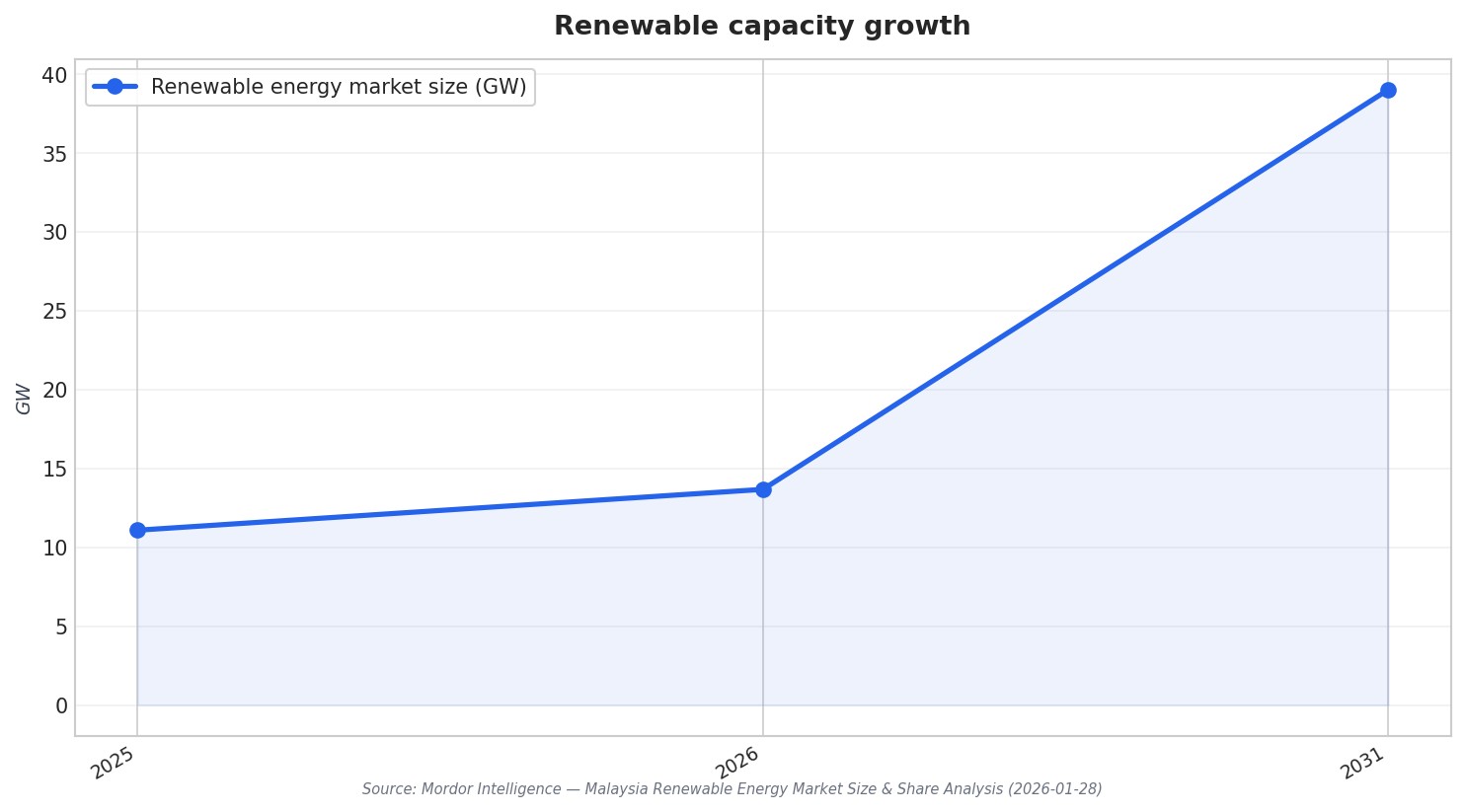
Grid investment is a core enabling theme inside the transition. Mordor Intelligence cites TNB’s capital expenditure commitment of MYR 42.9 billion (USD 10.2 billion), with 64% earmarked for grid reinforcement, including new inter-regional circuits and advanced system operator tools. The same source also describes how NETR measures can “ease the 24% solar-penetration cap on peak demand,” creating additional headroom for variable generation. For market context, Mordor Intelligence estimates Malaysia’s renewable energy market at 11.09 GW in 2025 and 13.68 GW in 2026, with a projection of 39.03 GW by 2031, and it attributes growth outlook drivers to the NETR, rising corporate power-purchase agreements, and declining solar PV levelized costs.
The roadmap also has clear implications for industry and commercial energy users. One NETR-focused analysis says Malaysia’s industrial sector uses roughly a third of the national electricity supply and that when industrial process emissions are included, the sector accounts for over 30% of Malaysia’s total emissions. It also cites an NETR target of approximately 22% energy savings by 2040 for the industrial and commercial (C&I) sector. This C&I focus aligns with demand-side growth signals elsewhere in the sources, including rising corporate PPAs associated with data centers. Mordor Intelligence reports data-center investments of MYR 162 billion booked from 2021 to H1 2024, underpinning longer-term offtake commitments under the Corporate Renewable Energy Supply Scheme (CRESS). Together, these elements show how the National Energy Transition Roadmap Malaysia agenda is designed to connect power-system upgrades, project rollout, and real-economy demand.
When was Malaysia’s National Energy Transition Roadmap unveiled, and what pillars does it cover?
How much investment and seed funding are linked to NETR Phase 1?
What flagship projects are listed under NETR Phase 1?
What renewable-energy milestones are associated with the NETR?
How does the National Energy Transition Roadmap in Malaysia affect industry and commercial energy use?