
Closing the financing gap starts with a clear view of why it exists. Malaysia has over 1.08 million MSME establishments, and MSMEs account for 96.1% of all businesses. They are also linked to 39.5% of GDP and 48.7% of national employment. Yet access to formal financing remains a persistent challenge, especially for micro and early-stage firms that do not meet commercial bank eligibility requirements. One estimate puts the MSME funding gap at MYR 90 billion. This mismatch matters because financing is often needed for working capital, day-to-day stability, and business transformation.
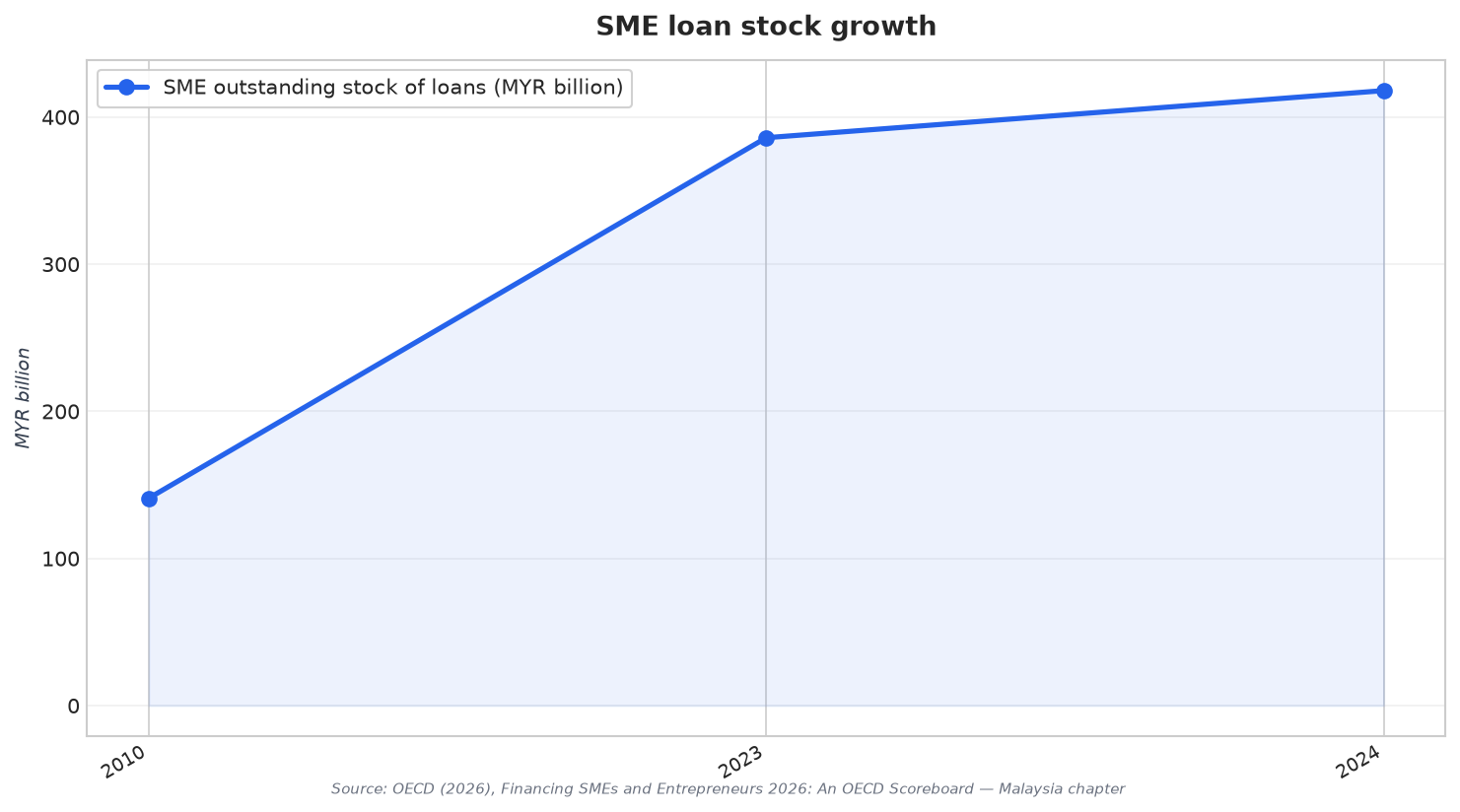
The banking system has still expanded credit, and that growth can be used as a platform for more inclusive risk-taking. OECD reporting notes that financing to businesses grew by 5.1% in 2024, up from 3.7% in 2023. Within that, outstanding SME financing grew by 8.1% in 2024 (8.7% in 2023), supported by continued disbursements mainly for working capital purposes. Over a longer horizon, the total value of SME outstanding stock of loans rose from MYR 141 billion in 2010 to MYR 418 billion in 2024 (MYR 386 billion in 2023). The opportunity is to keep growth disciplined while reaching viable firms that standard processes miss.
Guarantees, Targeted Facilities, and Better Underwriting
Public tools can help bridge gaps when they are designed to complement, not substitute, commercial lending. Bank Negara Malaysia (BNM) and Credit Guarantee Corp Malaysia Bhd (CGC) introduced the BNM-CGC Guarantee Scheme, which supports up to RM10 bil in guaranteed financing through participating financial institutions. The stated intent is risk-sharing for viable but underserved SMEs, including those lacking conventional collateral or not fitting traditional profiles. The Star also highlights the policy principle: guarantees and targeted facilities should crowd in private financing while maintaining market discipline through sound underwriting, appropriate risk-sharing, and transparency over public exposures.
A key constraint is underwriting that depends heavily on credit bureau history, which can exclude newly established businesses. Research on cash flow underwriting in Malaysia argues that bank statements provide up-to-date and verifiable financial behaviour, capturing income regularity, spending patterns, and cash flow stability. The study introduces a dataset of 611 loan applicants from a Malaysian lending institution and reports that using bank transaction-derived features boosts model performance on that dataset. In practice, this supports a shift toward more data-driven, less collateral-dependent lending, while still requiring rigorous credit assessment and monitoring to keep risk-sharing sustainable.
More diverse channels can also make Malaysia SME financing feel less binary than “bank loan or nothing.” A 2026 guide describes BNM special fund schemes such as the Automation and Digitalisation Facility (ADF), with financing rates of up to 3.75% per annum inclusive of a guarantee fee and a maximum loan amount of RM5 million per SME, submitted via participating financial institutions. The same guide notes that major banks may require at least 2 years of business operation, a clean CCRIS/CTOS record, and audited financial statements. Meanwhile, Malaysia’s fintech landscape shows momentum in digital lending at 21.03%, alongside a MYR 1.5 billion (USD 315 million) Business Digitalisation Initiative that subsidizes digital tools and financing. Together, these pathways widen options for different SME tiers without abandoning prudent credit standards.
What is driving the SME financing gap in Malaysia?
How has SME loan growth changed recently in Malaysia?
What is the BNM-CGC Guarantee Scheme designed to do?
How can cash flow underwriting help expand access to Malaysia SME financing?
What are examples of structured financing options for SMEs in 2026?