Malaysia’s private GP clinics are facing a sustained squeeze that is now visible in national reporting and professional surveys. A Malaysian Medical Association (MMA) report cited in the media said more than 70% of the country’s 10,000 private GP clinics are struggling to stay afloat. Another MMA survey involving nearly 2,000 GP clinics found that over 70% are earning less than RM60,000 a month, with many owners saying this is not enough to cover basic operating costs such as rent, staffing, and utilities. The risk is not only commercial. If front-line clinics close, access and workload pressures can spill over into other parts of the health system.
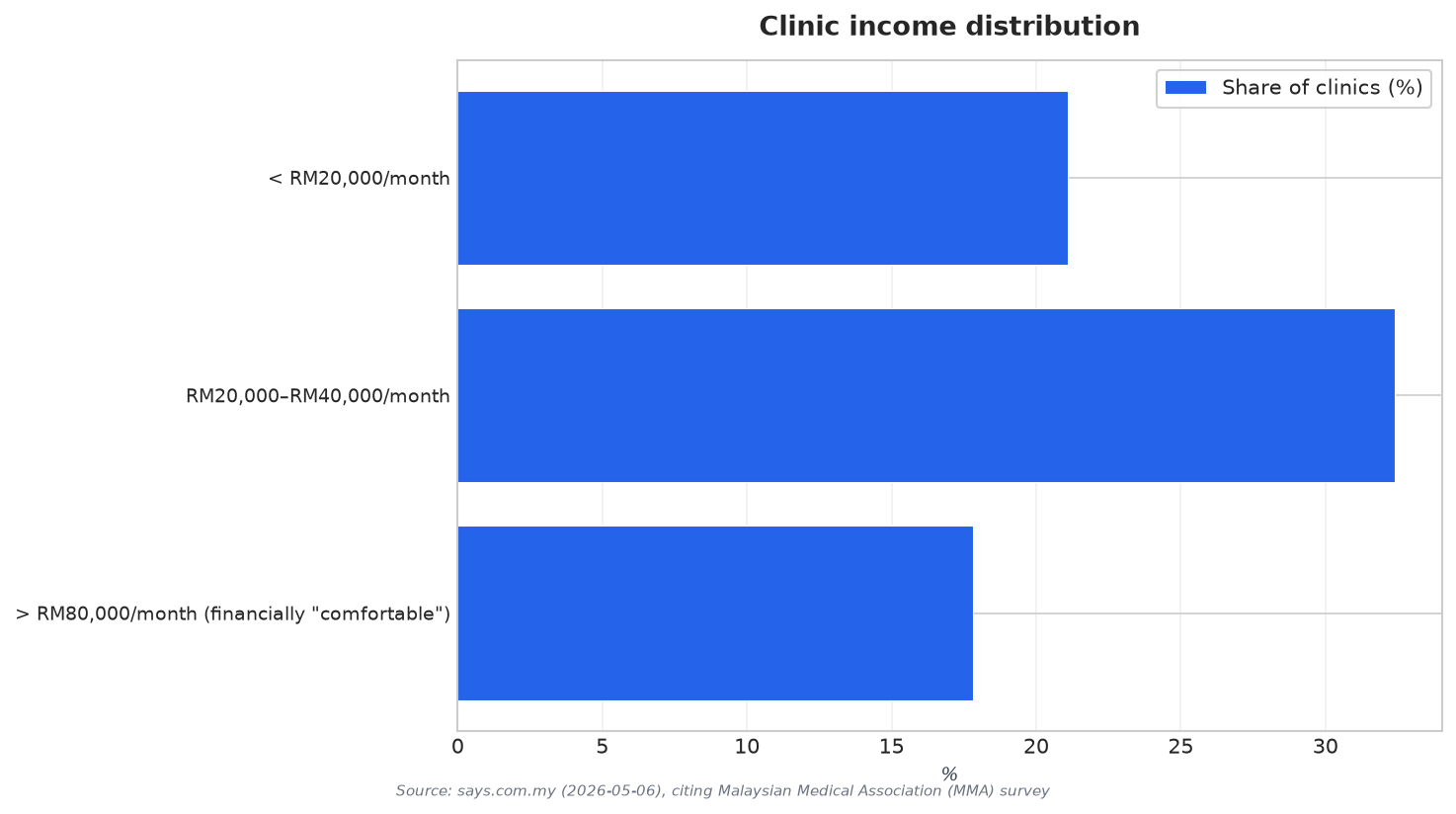
The income distribution described in the MMA-linked reporting shows why many operators feel trapped. About 21.1% of surveyed clinics earn less than RM20,000 a month, while 32.4% earn between RM20,000 and RM40,000. Only 17.8% are described as financially “comfortable”, earning more than RM80,000 per month. At the same time, cost pressure is rising, with medicines and medical supplies cited as getting more expensive, partly linked to global supply chain disruptions. Smaller clinics also lack bulk purchasing power, making it harder to defend margins without raising prices in a competitive market.
Primary Care Capacity Exists, but the System Is Misaligned
Policy and system design issues add another layer of stress. CodeBlue reported arguments that Malaysia does not have a GP shortage so much as a primary care design problem, with thousands of GP clinics operating below potential capacity even as public hospitals face heavy outpatient demand, long waits, and stretched clinicians. The same commentary stresses that private GPs can manage stable chronic conditions, preventive care, and medication titration, but incentives and pathways are not aligned. Clinical information also does not move seamlessly between public and private sectors, which makes coordinated care difficult and discourages safe decentralisation. Shared electronic medical records, referral protocols, and digital care coordination are highlighted as essential building blocks.
Recent parliamentary reporting adds hard context on the size of the ecosystem and the closure risk. In remarks reported by The Edge Malaysia, the primary healthcare system was described as comprising 2,916 MOH health clinics and 10,208 private GP clinics. In the same exchange, it was said that 2,034 private medical clinics reportedly closed since 2013. The Ministry of Health indicated it is committed to sustaining private clinic operations and framed structured collaboration between public and private providers as crucial to balancing burdens, including in non-communicable disease management under the 13th Malaysia Plan. These figures underline why keeping community clinics viable is a system-level concern.
Digital disruption is now a decisive competitive and operational factor for Malaysia primary healthcare clinics, but the benefits are uneven. Patients increasingly search online, check availability, read reviews, and often book before they visit, which means clinics that are hard to find online can lose demand before any consultation happens. Yet Healthcare IT News also warns that digitisation remains fragmented and uneven, and that some tools increase administrative burden through repeated data entry and compliance-heavy workflows. Clinics that adapt focus on removing manual steps such as patient registration, hand-typed billing, repeated documentation, and spreadsheet-based inventory. The goal is practical: reduce admin time so staff can focus on patient-facing care and steadier clinic operations.
What share of Malaysia’s private GP clinics are reported to be struggling?
What do MMA-linked figures show about monthly income levels for clinics?
How many primary care clinics are there across public and private sectors?
How does digital disruption affect Malaysia primary healthcare clinics and patient choice?
Why do some experts say the issue is primary care design rather than a GP shortage?