Malaysia’s mySalam B40 National Protection Scheme is being positioned as a wider safety net by linking eligibility to Sumbangan Tunai Rahmah (STR). Based on this year’s criteria, 9.15 million STR recipients are eligible for benefits under mySalam. Finance Minister II Datuk Seri Amir Hamzah Azizan said the programme has been effective in easing healthcare cost burdens for the B40 community, and he cited an upward trajectory in usage. That trend matters because mySalam is meant to support people who may struggle with critical illness and hospitalisation costs, and the government is now assessing how to keep the scheme relevant and responsive.
Since mySalam launched in 2019 until Dec 31, 2025, 1.88 million individuals received payouts totalling RM1.42 billion (reported as RM1.423 billion in a June 12 update). A separate breakdown shared by Communications Minister Datuk Fahmi Fadzil said over 1.294 million recipients received hospitalisation benefits amounting to RM394.87 million, while 13,128 recipients received medical device assistance worth RM65.257 million. He also described a one-off payment of up to RM8,000 for recipients diagnosed with any of 50 listed critical illnesses. Eligible recipients include STR beneficiaries and their spouses aged up to 65.
What Rising Claims and Remaining Funds Signal
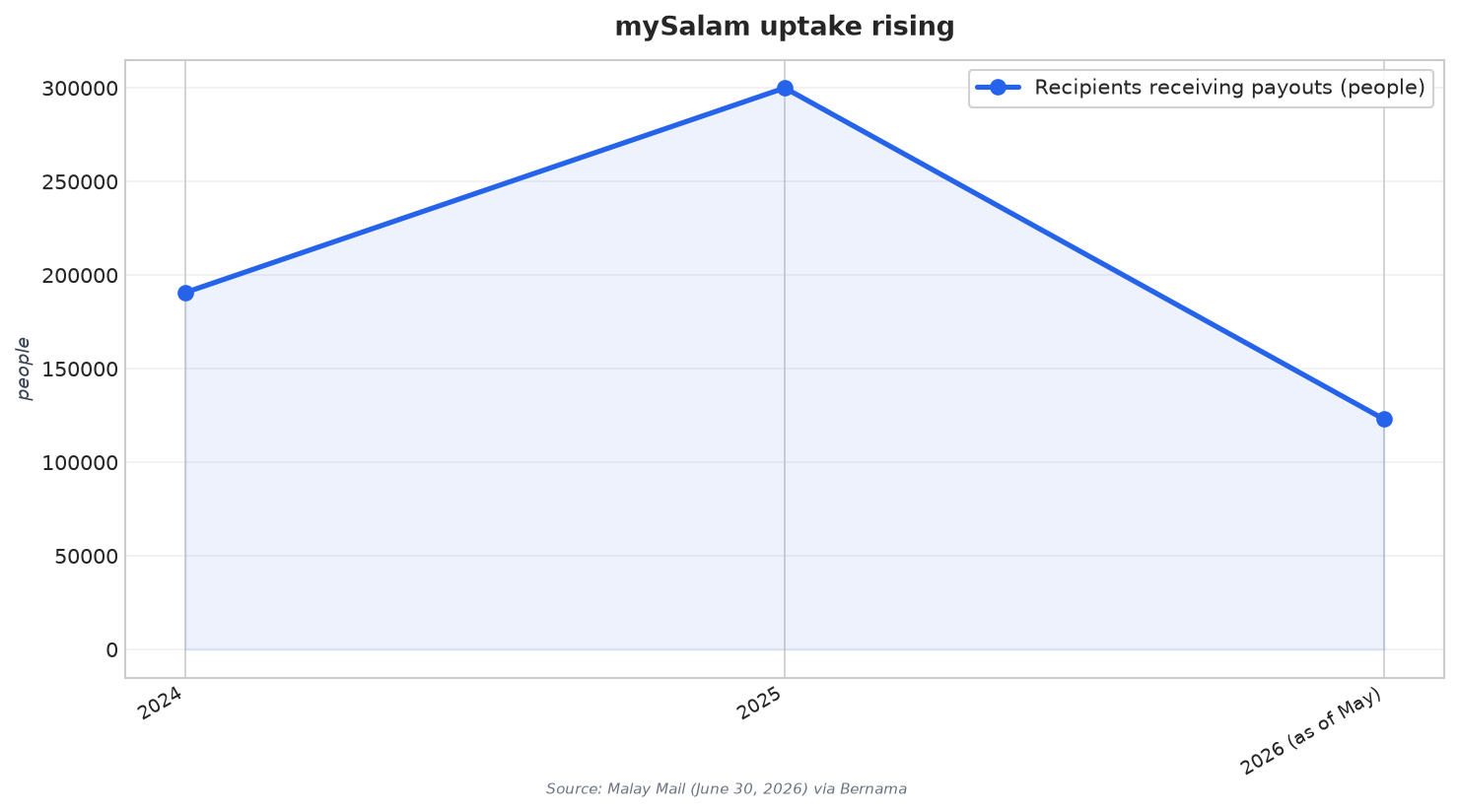
Recent claim patterns suggest the protection is being used more actively. Amir Hamzah said nearly 300,000 individuals received benefits last year, with claims totalling RM276 million, compared with 190,725 recipients in 2024. As of May 2026, an estimated 123,000 recipients had received payouts amounting to RM108 million. On funding, he reported a remaining fund balance of RM490.9 million as of end-2025, and said it was around RM290 million after mid-year utilisation. He added that the government is looking into extending mySalam for another year, while continuing to refine the scheme.
Alongside expansion, scrutiny has also highlighted where protection may not translate into payouts for everyone who applies. CodeBlue, citing the mySalam 2024 annual report, reported that from 2019 to 2024 the scheme paid out 54% of total claims submitted nationwide: 1,088,400 paid out of 2,009,500 claims. The same report noted that most rejected claims stemmed from documentation gaps, such as missing a hospital discharge note, or misunderstanding requirements, such as not having a diagnosis for one of the 50 approved critical illnesses. The Ministry of Finance spokesperson told CodeBlue the government recognises the need to strengthen public awareness.
For households trying to understand mySalam STR healthcare coverage, the story is moving in two directions at once: broader eligibility on one hand, and a continued need to improve claim readiness on the other. The eligibility link to STR, the age cap up to 65 for recipients and spouses, and the defined benefits for hospitalisation, critical illness, and medical devices shape how much real-world help people can access. With the government reviewing an extension and tracking usage, the next phase will likely focus not only on sustaining funds, but also on ensuring more valid claims can be completed correctly.
How many STR recipients are eligible for mySalam benefits this year?
How much has mySalam paid out since it started?
What do recent figures show about mySalam claim activity?
Is the government considering extending mySalam, and what funds remain?
What should people know about mySalam STR healthcare coverage and claim approval?