Malaysia’s freight and logistics sector is already being pulled by several big demand engines, and Budget 2027 will be judged by whether it removes friction where volume is rising fastest. Research snapshots point to an industry with strong growth expectations, but also operational pressure points. One forecast values the Malaysia Freight and Logistics market at USD 55.3 billion in 2024 and projects USD 89.7 billion by 2032, at a 6.3% CAGR during 2026–2032. Another expects the Malaysia Freight Logistics Market to grow from USD 33.49 billion in 2026 to USD 54.30 billion by 2035, at a 5.52% CAGR. With estimates varying by source and scope, the practical Budget 2027 question is simpler: can the system move more shipments reliably, across road, sea, air, and rail, without turning congestion and cost into a growth tax?
E-commerce and last-mile performance set the tempo for day-to-day capacity planning, and that is where a 2027 budget signal can influence investment timing. Malaysia’s internet retail sales index grew 9.5% year over year in September 2025, and DOSM cited 9.9 online sales events that stimulated demand and pushed transaction volumes across major platforms. At the service level, leading platforms are shipping 95% of orders within 24 hours, while 64.8% of internet users prefer free delivery. Those expectations drive automated sortation, micro-fulfillment centers, and data-driven route planning. Budget decisions that support faster, simpler clearance and enable warehouse and delivery upgrades could matter more than headline announcements, because peak-event order clustering forces logistics providers to add flexible sorting and dispatch shifts without carrying that same capacity through quieter weeks.
Infrastructure, Cross-Border Flow, and the Corridors That Win
Manufacturing-linked freight is another clear driver, and it is tied to investment and output cycles. Malaysia’s manufacturing output increased 7.4% year over year in August 2026, after 6.4% in July, with the August reading listed as provisional. Manufacturing also accounted for 34.5% of Malaysia’s accumulated foreign direct investment position at the end of Q2 2026. Separately, one market overview reports foreign direct investment reached MYR 378.5 billion (USD 82.3 billion) in 2024, creating 207,000 jobs, with knock-on demand for cross-border forwarding, value-added distribution, and specialized manufacturing logistics. Another source adds that Malaysia attracted approved manufacturing investments exceeding MYR 155 billion in 2024, with semiconductor and electrical-electronics projects accounting for nearly 40% of the total. In that context, Budget 2027 discussions about logistics become discussions about protecting service reliability for factories, including inbound materials, outbound finished goods, and repeat packaging loops.
Infrastructure works also create near-term construction cargo flows and, later, new operating-network demand. Malaysia Rail Link reported East Coast Rail Link construction was 95.41% complete as of August 2026. On roads, Malaysia’s Works Minister reported that 31 of 35 Sabah Pan Borneo Highway Phase 1 packages remained under implementation on August 25, 2026. That split matters operationally: construction logistics can ramp early, while feeder freight capacity depends on clear operating milestones. In parallel, cross-border facilitation is already moving. The Johor–Singapore Special Economic Zone’s single transshipment permit, implemented in January 2025, removed duplicate customs filings and cut clearance times by roughly two hours per trip. With the Rapid Transit System Link opening in 2027 and a uCustoms green-channel target of 80%, industrial estates in Johor and western Singapore plan capacity additions that may lift bilateral truck moves by a compounded 6–7% annually.
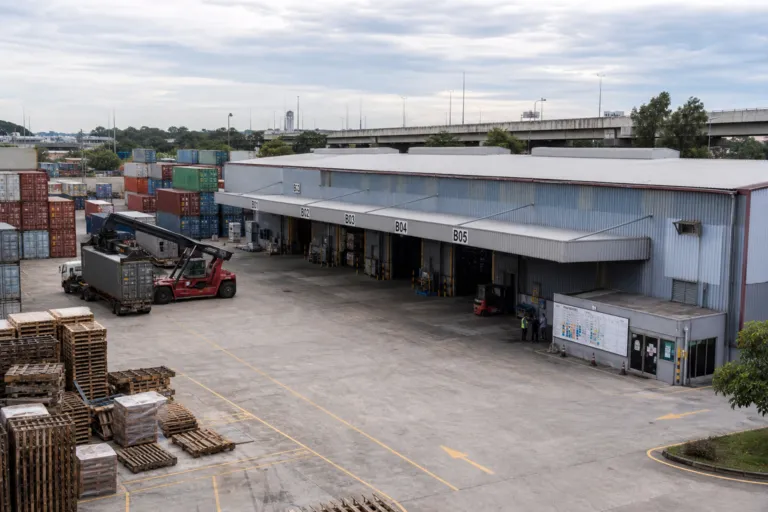
Competitive structure also shapes how budget measures land in the real market. One report describes low concentration, with the top five players estimated at 20–28% of total revenue and an HHI below 500, pointing to fragmentation where domestic specialists, regional integrators, and global forwarders coexist. That means Budget 2027 implications may show up as uneven adoption: larger networks can invest faster, while smaller operators may focus on niche corridors or sector depth. For market geography, one estimate says the Central Region held 44.6% of the Malaysia Freight Logistics Market, benefiting from Port Klang and KLIA, while the Southern Region is projected as the fastest-growing corridor with a 6.35% CAGR. Port-side pressure also cannot be ignored; one overview notes Red Sea rerouting has intensified arrival bunching and yard overflow, contributing to short-term charter premium spikes and inventory imbalances. In that environment, Malaysia Budget 2027 logistics debates will likely center on throughput resilience, border speed, and the readiness of corridors that carry manufacturing and e-commerce volumes.
How could Budget 2027 affect Malaysia’s logistics and freight priorities?
What recent indicators show e-commerce pressure on logistics operations?
What figures link manufacturing to freight demand in Malaysia?
Which infrastructure projects are highlighted as relevant to logistics capacity planning?
What changes are shaping the Johor–Singapore cross-border logistics corridor?